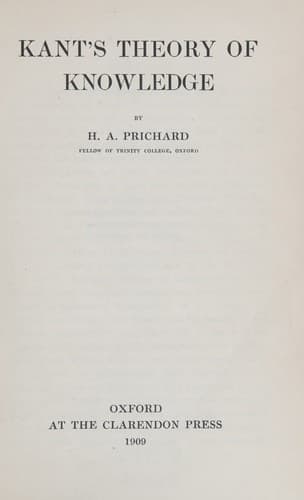
Kant's Theory of KnowledgePrichard, H. A. (Harold Arthur)
Philosophy
Kant's Theory of Knowledge
Prichard, H. A. (Harold Arthur)
Kant, Immanuel, 1724-1804; Knowledge, Theory of
Before, however, we attempt to prove this, it is necessary to draw
attention to three features of the argument. In the _first_ place, it
implies a somewhat different account of self-consciousness to that
implied in the passages of the first edition which we have already
considered. Self-consciousness, instead of being the consciousness of
the identity of our activity in combining the manifold, is now
primarily the consciousness of ourselves as identical subjects of all
our representations, i. e. it is what Kant calls the analytical unity
of apperception; and consequently it is somewhat differently related
to the activity of synthesis involved in knowledge. Instead of being
regarded as the consciousness of this activity, it is regarded as
presupposing the consciousness of the product of this activity, i. e.
of the connectedness[70] of the manifold produced by the activity,
this consciousness being what Kant calls the synthetical unity of
apperception.[71] In the _second_ place, it is plain that Kant's view
is not that self-consciousness involves the consciousness of our
representations as a connected whole, but that it involves the
consciousness of them as capable of being connected by a synthesis.
Yet, if it is only because I can connect (and therefore apprehend as
connected) a manifold of representations in one consciousness, that I
can represent to myself the identity of consciousness in these
representations, self-consciousness really requires the consciousness
of our representations as _already_ connected; the mere consciousness
of our representations as _capable_ of being connected would not be
enough. The explanation of the inconsistency seems to lie in the fact
that the synthetic unity of which Kant is thinking is the unity
of nature. For, as Kant of course was aware, in our ordinary
consciousness we do not apprehend the interconnexion of the parts
of nature in detail, but only believe that there is such an
interconnexion; consequently he naturally weakened the conclusion
which he ought to have drawn, viz. that self-consciousness presupposes
consciousness of the synthesis, in order to make it conform to the
facts of our ordinary consciousness. Yet, if his _argument_ is
to be defended, its conclusion must be taken in the form that
self-consciousness presupposes consciousness of the actual synthesis
or connexion and not merely of the possibility of it. In the _third_
place, Kant twice in this passage[72] definitely makes the act of
synthesis, which his argument maintains to be the condition of
_consciousness of the identity_ of ourselves, the condition of the
_identity_ of ourselves. The fact is that, on Kant's view, the act of
synthesis of the representations is really a condition of their
belonging to one self, the self being presupposed to be a self capable
of self-consciousness.[73]
[70] More accurately, 'of the possibility of the
connectedness'.
Public-domain text, read in full here on John Shaqi.
Reviews
Reviews
No reviews yet
Be the first to share your thoughts on this work.
Elsewhere in the archive
Join the Discussion
Join the discussion
Sign in to leave a comment or review.
Sign InorCreate an account