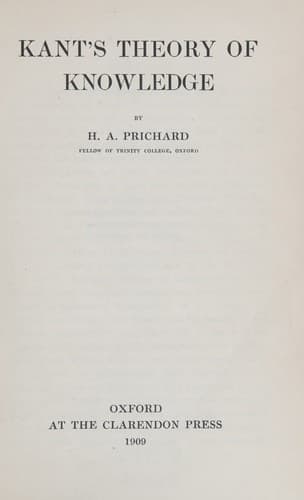
Kant's Theory of KnowledgePrichard, H. A. (Harold Arthur)
Philosophy
Kant's Theory of Knowledge
Prichard, H. A. (Harold Arthur)
Kant, Immanuel, 1724-1804; Knowledge, Theory of
Nevertheless, a plausible defence of Kant's treatment of causality can
be found, which may be formulated thus: 'Time, just as much as space,
is a sphere within which we have to distinguish between appearance and
reality. For instance, when moving in a lift, we see, as we say, the
walls moving, while the lift remains stationary. When sitting in a
train which is beginning to move out of a station, we see, as we say,
another train beginning to move, although it is in fact standing
still. When looking at distant trees from a fast train, we see, as we
say, the buildings in the intermediate space moving backwards. In
these cases the events seen are not real, and we only succeed in
determining what is really happening, by a process which presupposes
the law of causality. Thus, in the last case we only believe that the
intermediate buildings do not move, by realizing that, given the
uniformity of nature, belief in their motion is incompatible with what
we believe on the strength of experience of these buildings on other
occasions and of the rest of the world. These cases prove the
existence of a process which enables us, and is required to enable us,
to decide whether a given change is objective or subjective, i. e.
whether it lies in the reality apprehended or in our apprehension of
it; and this process involves an appeal to causality. Kant's mistake
lay in his choice of illustrations. His illustrations implied that the
process which involves causality is one by which we distinguish a
succession in the object apprehended from another relation in the
object, viz. a coexistence of bodies. But he ought to have taken
illustrations which implied that the process is one by which we
distinguish a succession in the object from a succession in our
perception of it. In other words, the illustrations should, like those
just given, have illustrated the process by which we distinguish an
objective from a subjective change, and not a process by which we
distinguish an objective change from something else also objective.
Consequently, Kant's conclusion and his _general_ method of treatment
are right, even if, misled by his instances, he supports his position
by arguments which are wrong.'
Public-domain text, read in full here on John Shaqi.
Reviews
Reviews
No reviews yet
Be the first to share your thoughts on this work.
Elsewhere in the archive
Join the Discussion
Join the discussion
Sign in to leave a comment or review.
Sign InorCreate an account