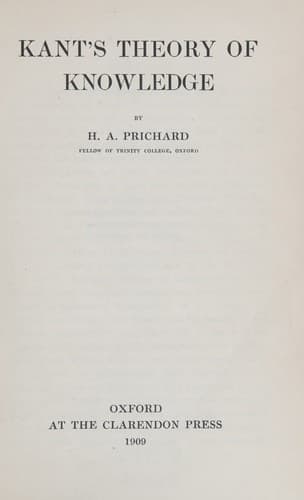
Kant's Theory of KnowledgePrichard, H. A. (Harold Arthur)
Philosophy
Kant's Theory of Knowledge
Prichard, H. A. (Harold Arthur)
Kant, Immanuel, 1724-1804; Knowledge, Theory of
This defence is, however, open to the following reply: 'At first sight
the cases taken undoubtedly seem to illustrate a process in which we
seek to discover whether a certain change belongs to objects or only
to our apprehension of them, and in which we appeal to causality in
arriving at a decision. But this is only because we ignore the
relativity of motion. To take the third case: our first statement of
the facts is that we saw the intermediate buildings moving, but that
subsequent reflection on the results of other experience forced us to
conclude that the change perceived was after all only in our
apprehension and not in the things apprehended. The statement,
however, that we saw the buildings moving really assumes that we, the
observers, were stationary; and it states too much. What we really
perceived was a relative changing of position between us, the near
buildings, and the distant trees. This is a fact, and the apprehension
of it, therefore, does not afterwards prove mistaken. It is equally
compatible with motion on the part of the trees, or of the buildings,
or of the observers, or of a combination of them; and that for which
an appeal to causality is needed is the problem of deciding which of
these alternatives is correct. Moreover, the perceived relative change
of position is objective; it concerns the things apprehended. Hence,
in this case too, it can be said that we perceive an objective
succession from the beginning, and that the appeal to causality is
only needed to determine something further about it. It is useless to
urge that to be aware of an event is to be aware of it in all its
definiteness, and that this awareness admittedly involves an appeal to
causality; for it is easy to see that unless our awareness of the
relative motion formed the starting-point of any subsequent process in
which we appealed to the law of causality, we could never use the law
to determine which body really moved.'
Two remarks may be made in conclusion. In the first place, the basis
of Kant's account, viz. the view that in our apprehension of the world
we advance from the apprehension of a succession of perceptions to
the apprehension of objects perceived, involves a [Greek: hysteron
proteron]. As Kant himself in effect urges in the _Refutation of
Idealism_,[47] self-consciousness, in the sense of the consciousness
of the successive process in which we apprehend the world, is plainly
only attained by reflecting upon our apprehension of the world. We
first apprehend the world and only by subsequent reflection become
aware of our activity in apprehending it. Even if consciousness of
the world must lead to, and so is in a sense inseparable from,
self-consciousness, it is none the less its presupposition.
[47] Cf. p. 320.
Public-domain text, read in full here on John Shaqi.
Reviews
Reviews
No reviews yet
Be the first to share your thoughts on this work.
Elsewhere in the archive
Join the Discussion
Join the discussion
Sign in to leave a comment or review.
Sign InorCreate an account