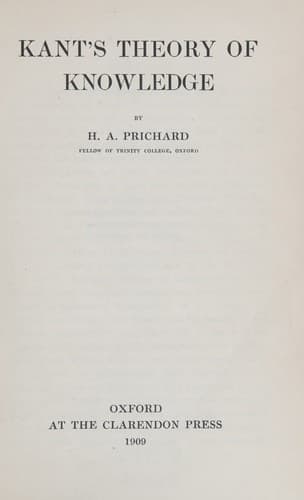
Kant's Theory of KnowledgePrichard, H. A. (Harold Arthur)
Philosophy
Kant's Theory of Knowledge
Prichard, H. A. (Harold Arthur)
Kant, Immanuel, 1724-1804; Knowledge, Theory of
"Things are _coexistent_, when in empirical intuition[51] the
perception[52] of the one can follow upon the perception of the other,
and vice versa (which cannot occur in the temporal succession of
phenomena, as we have shown in the second principle). Thus I can
direct my perception first to the moon and afterwards to the earth, or
conversely, first to the earth and then to the moon, and because the
perceptions of these objects can reciprocally follow each other, I say
that they coexist. Now coexistence is the existence of the manifold in
the same time. But we cannot perceive time itself, so as to conclude
from the fact that things are placed in the same time that the
perceptions of them can follow each other reciprocally. The synthesis
of the imagination in apprehension, therefore, would only give us each
of these perceptions as existing in the subject when the other is
absent and vice versa; but it would not give us that the objects are
coexistent, i. e. that, if the one exists, the other also exists in
the same time, and that this is necessary in order that the
perceptions can follow each other reciprocally. Hence there is needed
a conception-of-the-understanding[53] of the reciprocal sequence of
the determinations of these things coexisting externally to one
another, in order to say that the reciprocal succession of perceptions
is grounded in the object, and thereby to represent the coexistence as
objective. But the relation of substances in which the one contains
determinations the ground of which is contained in the other is the
relation of influence, and if, reciprocally, the former contains the
ground of the determinations in the latter, it is the relation of
community or interaction. Consequently, the coexistence of substances
in space cannot be known in experience otherwise than under the
presupposition of their interaction; this is therefore also the
condition of the possibility of things themselves as objects of
experience."[54]
[51] _Anschauung._
[52] _Wahrnehmung._
[53] _Verstandesbegriff._
[54] B. 257-8, M. 156-7.
Public-domain text, read in full here on John Shaqi.
Reviews
Reviews
No reviews yet
Be the first to share your thoughts on this work.
Elsewhere in the archive
Join the Discussion
Join the discussion
Sign in to leave a comment or review.
Sign InorCreate an account