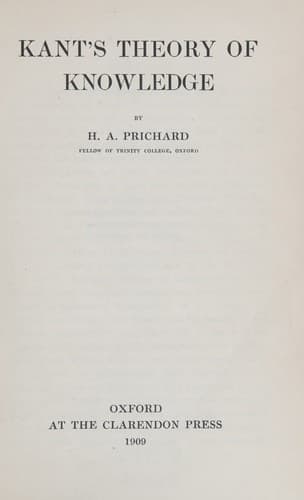
Kant's Theory of KnowledgePrichard, H. A. (Harold Arthur)
Philosophy
Kant's Theory of Knowledge
Prichard, H. A. (Harold Arthur)
Kant, Immanuel, 1724-1804; Knowledge, Theory of
In the second place, it seems that the true vindication of causality,
like that of the first analogy, lies in the dogmatic method which Kant
rejects. It consists in insight into the fact that it is of the very
nature of a physical event to be an element in a process of change
undergone by a system of substances in space, this process being
through and through necessary in the sense that any event (i. e. the
attainment of any state by a substance) is the outcome of certain
preceding events (i. e. the previous attainment of certain states by
it and other substances), and is similarly the condition of certain
subsequent events.[48] To attain this insight, we have only to reflect
upon what we really mean by a 'physical event'. The vindication can
also be expressed in the form that the very _thought_ of a physical
event presupposes the _thought_ of it as an element in a necessary
process of change--provided, however, that no distinction is implied
between the nature of a thing and what we think its nature to be. But
to vindicate causality in this way is to pursue the dogmatic method;
it is to argue from the nature, or, to use Kant's phrase, from the
conception, of a physical event. On the other hand, it seems that the
method of arguing transcendentally, or from the possibility of
perceiving events, must be doomed to failure in principle. For if, as
has been argued to be the case,[49] apprehension is essentially the
apprehension of a reality as it exists independently of the
apprehension of it, only those characteristics can be attributed to
it, as characteristics which it must have if it is to be apprehended,
which belong to it in its own nature or in virtue of its being what it
is. It can only be because we think that a thing has some
characteristic in virtue of its own nature, and so think
'dogmatically', that we can think that in apprehending it we must
apprehend it as having that characteristic.[50]
[48] This statement of course includes the third analogy.
[49] Cf. Chh. IV and VI.
[50] Cf. p. 275.
There remains to be considered Kant's proof of the third analogy,
i. e. the principle that all substances, so far as they can be
perceived in space as coexistent, are in thorough-going interaction.
The account is extremely confused, and it is difficult to extract from
it a consistent view. We shall consider here the version added in the
second edition, as being the fuller and the less unintelligible.
Public-domain text, read in full here on John Shaqi.
Reviews
Reviews
No reviews yet
Be the first to share your thoughts on this work.
Elsewhere in the archive
Join the Discussion
Join the discussion
Sign in to leave a comment or review.
Sign InorCreate an account