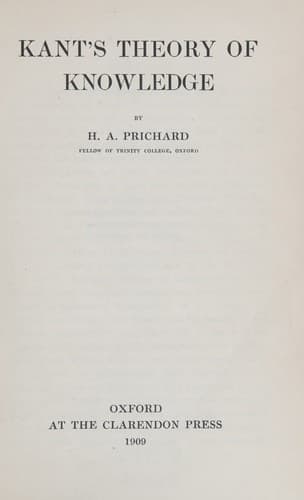
Kant's Theory of KnowledgePrichard, H. A. (Harold Arthur)
Philosophy
Kant's Theory of Knowledge
Prichard, H. A. (Harold Arthur)
Kant, Immanuel, 1724-1804; Knowledge, Theory of
It is now necessary to consider how the distinction between the
sensibility and the understanding contributes to articulate the
problem 'How are _a priori_ synthetic judgements possible?' As has
been pointed out, Kant means by this question, 'How is it possible
that the mind is able, in virtue of its own powers, to make universal
and necessary judgements which anticipate its experience of objects?'
To this question his general answer is that it is possible and only
possible because, so far from ideas, as is generally supposed, having
to conform to things, the things to which our ideas or judgements
relate, viz. phenomena, must conform to the nature of the mind. Now,
if the mind's knowing nature can be divided into the sensibility and
the understanding, the problem becomes 'How is it possible for the
mind to make such judgements in virtue of its sensibility and its
understanding?' And the answer will be that it is possible because the
things concerned, i. e. phenomena, must conform to the sensibility and
the understanding, i. e. to the mind's perceiving and thinking nature.
But both the problem and the answer, so stated, give no clue to the
particular _a priori_ judgements thus rendered possible nor to the
nature of the sensibility and the understanding in virtue of which we
make them. It has been seen, however, that the judgements in question
fall into two classes, those of mathematics and those which form the
presuppositions of physics. And it is Kant's aim to relate these
classes to the sensibility and the understanding respectively. His
view is that mathematical judgements, which, as such, deal with
spatial and temporal relations, are essentially bound up with our
perceptive nature, i. e. with our sensibility, and that the principles
underlying physics are the expression of our thinking nature, i. e. of
our understanding. Hence if the vindication of this relation between
our knowing faculties and the judgements to which they are held to
give rise is approached from the side of our faculties, it must be
shown that our sensitive nature is such as to give rise to
mathematical judgements, and that our understanding or thinking nature
is such as to originate the principles underlying physics. Again, if
the account of this relation is to be adequate, it must be shown to be
exhaustive, i. e. it must be shown that the sensibility and the
understanding give rise to no other judgements. Otherwise there may be
other _a priori_ judgements bound up with the sensibility and the
understanding which the inquiry will have ignored. Kant, therefore, by
his distinction between the sensibility and the understanding, sets
himself another problem, which does not come into sight in the first
formulation of the general question 'How are _a priori_ synthetic
judgements possible?' He has to determine what _a priori_ judgements
are related to the sensibility and to the understanding respectively.
At the same time the distinction gives rise to a division within the
Public-domain text, read in full here on John Shaqi.
Reviews
Reviews
No reviews yet
Be the first to share your thoughts on this work.
Join the Discussion
Join the discussion
Sign in to leave a comment or review.
Sign InorCreate an account