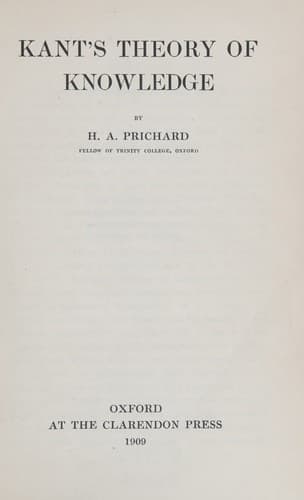
Kant's Theory of KnowledgePrichard, H. A. (Harold Arthur)
Philosophy
Kant's Theory of Knowledge
Prichard, H. A. (Harold Arthur)
Kant, Immanuel, 1724-1804; Knowledge, Theory of
CHAPTER XII
THE ANALOGIES OF EXPERIENCE 268
CHAPTER XIII
THE POSTULATES OF EMPIRICAL THOUGHT 308
NOTE
THE REFUTATION OF IDEALISM 319
REFERENCES
A = First edition of the _Critique of Pure Reason_.
B = Second edition of the _Critique of Pure Reason_.
Prol. = Kant's _Prolegomena to any future Metaphysic_.
M = Meiklejohn's Translation of the _Critique of Pure Reason_.
Mah. = Mahaffy. Translation of Kant's _Prolegomena to any future
Metaphysic_. (The pages referred to are those of the first
edition; these are also to be found in the text of the
second edition.)
Caird = Caird's _Critical Philosophy of Kant_.
CHAPTER I
THE PROBLEM OF THE _CRITIQUE_
The problem of the _Critique_ may be stated in outline and
approximately in Kant's own words as follows.
Human reason is called upon to consider certain questions, which it
cannot decline, as they are presented by its own nature, but which it
cannot answer. These questions relate to God, freedom of the will, and
immortality. And the name for the subject which has to deal with these
questions is metaphysics. At one time metaphysics was regarded as the
queen of all the sciences, and the importance of its aim justified the
title. At first the subject, propounding as it did a dogmatic system,
exercised a despotic sway. But its subsequent failure brought it into
disrepute. It has constantly been compelled to retrace its steps;
there has been fundamental disagreement among philosophers, and no
philosopher has successfully refuted his critics. Consequently the
current attitude to the subject is one of weariness and indifference.
Yet humanity cannot really be indifferent to such problems; even those
who profess indifference inevitably make metaphysical assertions; and
the current attitude is a sign not of levity but of a refusal to put
up with the illusory knowledge offered by contemporary philosophy. Now
the objects of metaphysics, God, freedom, and immortality, are not
objects of experience in the sense in which a tree or a stone is an
object of experience. Hence our views about them cannot be due to
experience; they must somehow be apprehended by pure reason, i. e. by
thinking and without appeal to experience. Moreover, it is in fact by
thinking that men have always tried to solve the problems concerning
God, freedom, and immortality. What, then, is the cause of the
unsatisfactory treatment of these problems and men's consequent
indifference? It must, in some way, lie in a failure to attain the
sure scientific method, and really consists in the neglect of an
inquiry which should be a preliminary to all others in metaphysics.
Men ought to have begun with a critical investigation of pure reason
itself. Reason should have examined its own nature, to ascertain in
general the extent to which it is capable of attaining knowledge
Public-domain text, read in full here on John Shaqi.
Reviews
Reviews
No reviews yet
Be the first to share your thoughts on this work.
Join the Discussion
Join the discussion
Sign in to leave a comment or review.
Sign InorCreate an account