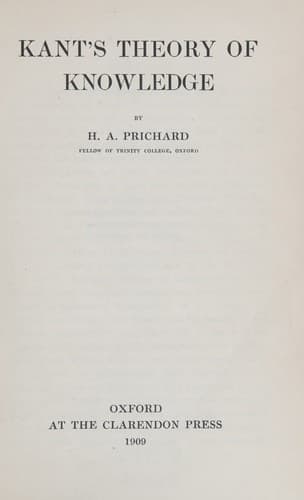
Kant's Theory of KnowledgePrichard, H. A. (Harold Arthur)
Philosophy
Kant's Theory of Knowledge
Prichard, H. A. (Harold Arthur)
Kant, Immanuel, 1724-1804; Knowledge, Theory of
[18] B. 35, M. 22 (quoted p. 39). It is noteworthy (1) that
the passage contains no _argument_ to show that extension and
shape are not, equally with divisibility, _thought_ to belong
to an object, (2) that impenetrability, which is here said
to belong to sensation, obviously cannot do so, and (3) that
(as has been pointed out, p. 39) the last sentence of the
paragraph in question presupposes that we have a perception
of empty space, and that this is a _form_ of perception.
There appears to be no way of distinguishing perception and conception
as the apprehension of different realities[19] except as the
apprehension of the individual and of the universal respectively.
Distinguished in this way, the faculty of perception is that in virtue
of which we apprehend the individual, and the faculty of conception is
that power of reflection in virtue of which a universal is made the
explicit object of thought.[20] If this be granted, the only test for
what is perceived is that it is individual, and the only test for what
is conceived is that it is universal. These are in fact the tests
which Kant uses. But if this be so, it follows that the various
characteristics of objects cannot be divided into those which are
perceived and those which are conceived. For the distinction between
universal and individual is quite general, and applies to all
characteristics of objects alike. Thus, in the case of colour, we can
distinguish colour in general and the individual colours of individual
objects; or, to take a less ambiguous instance, we can distinguish a
particular shade of redness and its individual instances. Further, it
may be said that perception is of the individual shade of red of the
individual object, and that the faculty by which we become explicitly
aware of the particular shade of red in general is that of conception.
The same distinction can be drawn with respect to hardness, or shape,
or any other characteristic of objects. The distinction, then,
between perception and conception can be drawn with respect to any
characteristic of objects, and does not serve to distinguish one from
another.
[19] And _not_ as mutually involved in the apprehension
of any individual reality.
[20] This distinction is of course different to that
previously drawn _within_ perception in the full sense
between perception in a narrow sense and conception
(pp. 28-9).
Public-domain text, read in full here on John Shaqi.
Reviews
Reviews
No reviews yet
Be the first to share your thoughts on this work.
Join the Discussion
Join the discussion
Sign in to leave a comment or review.
Sign InorCreate an account