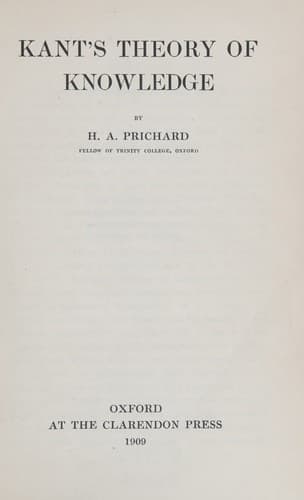
Kant's Theory of KnowledgePrichard, H. A. (Harold Arthur)
Philosophy
Kant's Theory of Knowledge
Prichard, H. A. (Harold Arthur)
Kant, Immanuel, 1724-1804; Knowledge, Theory of
[23] This contention is not refuted by the objection that our
distinct apprehension of an individual space is always bound
up with an indistinct apprehension of the spaces immediately
surrounding it. For our indistinct apprehension cannot be
supposed to be of the whole of the surrounding space.
[24] It is here assumed that a whole or a totality can be
infinite. Cf. p. 102.
In the _second_ place, the distinctions just drawn afford no ground
for distinguishing space as something perceived from any other
characteristic of objects as something conceived; for any other
characteristic admits of corresponding distinctions. Thus, with
respect to colour it is possible to distinguish (_a_) individual
colours which we perceive; (_b_) colouredness in general, which we
conceive by reflecting on the common character exhibited by individual
colours and which involves various kinds or species of colouredness;
(_c_) the totality of individual colours, the thought of which is
reached by considering the nature of colouredness in general.[25]
[25] For a possible objection and the answer thereto, see
note, p. 70.
Both in the case of colour and in that of space there is to be found
the distinction between universal and individual, and therefore also
that between conception and perception. It may be objected that after
all, as Kant points out, there is only one space, whereas there are
many individual colours. But the assertion that there is only one
space simply means that all individual bodies in space are related
spatially. This will be admitted, if the attempt be made to think of
two bodies as in different spaces and therefore as not related
spatially. Moreover, there is a parallel in the case of colour, since
individual coloured bodies are related by way of colour, e. g. as
brighter and duller; and though such a relation is different from a
relation of bodies in respect of space, the difference is due to the
special nature of the universals conceived, and does not imply a
difference between space and colour in respect of perception and
conception. In any case, space as a whole is not object of perception,
which it must be if Kant is to show that space, as being one, is
perceived; for space in this context must mean the totality of
individual spaces.
Public-domain text, read in full here on John Shaqi.
Reviews
Reviews
No reviews yet
Be the first to share your thoughts on this work.
Join the Discussion
Join the discussion
Sign in to leave a comment or review.
Sign InorCreate an account