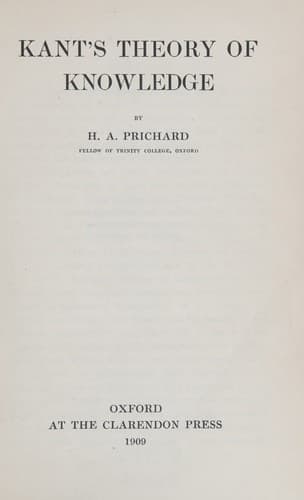
Kant's Theory of KnowledgePrichard, H. A. (Harold Arthur)
Philosophy
Kant's Theory of Knowledge
Prichard, H. A. (Harold Arthur)
Kant, Immanuel, 1724-1804; Knowledge, Theory of
things only _look_ coloured, so things may only _look_ spatial. We are
thus again[27] led to see that the issue really turns on the nature of
space and of spatial characteristics in particular.
[26] Cf. pp. 86-7.
[27] Cf. p. 79.
In discussing the distinction between the real and the apparent shape
of bodies, it was argued that while the nature of space makes it
necessary to distinguish in general between what a body looks and what
it is, yet the use of the term _look_ receives justification from the
existence of limiting cases in which what a thing looks and what it is
are identical. The instances considered, however, related to qualities
involving only two dimensions, e. g. convergence and bentness, and it
will be found that the existence of these limiting cases is due solely
to this restriction. If the assertion under consideration involves a
term implying three dimensions, e. g. 'cubical' or 'cylindrical',
there are no such limiting cases. Since our visual perception is
necessarily subject to conditions of perspective, it follows that
although we can and do see a cube, we can never see it as it _is_.
It _is_, so to say, in the way in which a child draws the side of a
house, i. e. with the effect of perspective eliminated; but it never
can be seen in this way. No doubt, our unreflective knowledge of the
nature of perspective enables us to allow for the effect of
perspective, and to ascertain the real shape of a solid object from
what it looks when seen from different points. In fact, the habit of
allowing for the effect of perspective is so thoroughly ingrained in
human beings that the child is not aware that he is making this
allowance, but thinks that he draws the side of the house as he sees
it. Nevertheless, it is true that we never see a cube as it is, and if
we say that a thing looks cubical, we ought only to mean that it looks
precisely what a thing looks which is a cube.
Public-domain text, read in full here on John Shaqi.
Reviews
Reviews
No reviews yet
Be the first to share your thoughts on this work.
Elsewhere in the archive
Join the Discussion
Join the discussion
Sign in to leave a comment or review.
Sign InorCreate an account