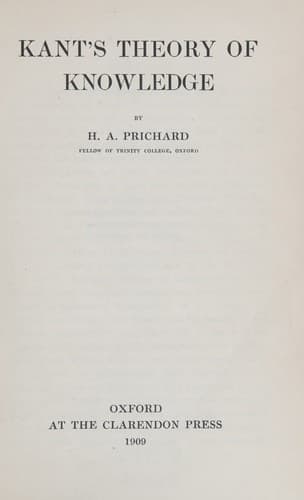
Kant's Theory of KnowledgePrichard, H. A. (Harold Arthur)
Philosophy
Kant's Theory of Knowledge
Prichard, H. A. (Harold Arthur)
Kant, Immanuel, 1724-1804; Knowledge, Theory of
It is obvious, however, that two dimensions are only an abstraction
from three, and that the spatial relations of bodies, considered
fully, involve three dimensions; in other words, spatial
characteristics are, properly speaking, three-dimensional. It follows
that terms which fully state spatial characteristics can never
express what things look, but only what they are. A body may be
cylindrical, and we may see a cylindrical body; but such a body can
never, strictly speaking, _look_ cylindrical. The opposition, however,
between what a thing _is_ and what it _looks_ implies that what it
_is_ is independent of a percipient, for it is precisely correlation
to a percipient which is implied by 'looking' or 'appearing'. In fact,
it is the view that what a thing really is it is, independently of
a percipient, that forms the real starting-point of Kant's thought.
It follows, then, that the spatial characteristics of things, and
therefore space itself, must belong to what they are in themselves
apart from a percipient, and not to what they look.[28] Consequently,
it is so far from being true that we only know what things look and
not what they are, that in the case of spatial relations we actually
know what things are, even though they never look what they are.
[28] This consideration disposes of the view that, if colour
is relative to perception, the primary qualities, as being
inseparable from colour, must also be relative to perception;
for it implies that the primary qualities cannot from their
very nature be relative to perception. Moreover, if the
possibility of the separation of the primary qualities from
colour is still doubted, it is only necessary to appeal to
the blind man's ability to apprehend the primary qualities,
though he may not even know what the word 'colour' means. Of
course, it must be admitted that some sensuous elements are
involved in the apprehension of the primary qualities, but
the case of the blind man shows that these may relate to
sight instead of to touch. Moreover, it, of course, does not
follow from the fact that sensuous elements are inseparable
from our perception of bodies that they belong to, and are
therefore inseparable from, the bodies perceived.
Public-domain text, read in full here on John Shaqi.
Reviews
Reviews
No reviews yet
Be the first to share your thoughts on this work.
Elsewhere in the archive
Join the Discussion
Join the discussion
Sign in to leave a comment or review.
Sign InorCreate an account