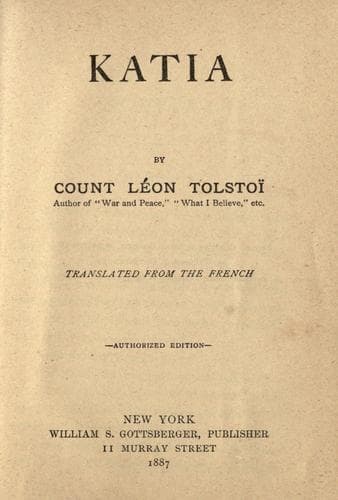
Man-woman relationships -- Fiction; Marriage -- Fiction; Russia -- Social life and customs -- 19th century -- Fiction
He rose very early, even during the winter, so that he was always gone
when I woke. He generally returned for tea, which we took alone
together; and at these times, having finished the troubles and
annoyances of his agricultural matters, he would often fall into that
particularly joyous light-hearted state of mind, which we used to call
_le transport sauvage_. Often, when I asked him to tell me what he had
been doing all the morning, he would relate such perfectly absurd
adventures, that we would almost die of laughing; sometimes when I
demanded a sober account, he would give it to me, making an effort to
restrain even a smile. As for me, I watched his eyes, or the motion of
his lips, and did not understand a word he said, being entirely taken up
with the pleasure of looking at him and hearing his voice.
"Come, now, what was I saying?" he would ask; "repeat it to me!"
But I never could repeat any of it.
Tatiana Semenovna never made her appearance until dinner time, taking
her tea alone, and only sending an ambassador to wish us good-morning. I
always found it hard not to burst out laughing, when the maid entered,
took her stand before us with her hands crossed one upon the other, and,
in her measured tones informed us that Tatiana Semenovna desired to know
whether we had slept well, and whether we liked the little cakes we had
for tea. Until dinner time we seldom remained together. I played, or
read, alone; he wrote, or sometimes went out again; but at four o'clock
we went down to the drawing-room for dinner. Mamma came out of her
chamber, and then the poor gentle-folk and pilgrims who happened to be
lodging in the house, usually two or three in number made their
appearance. Regularly every day my husband, following the ancient
custom, offered his arm to his mother, to conduct her to the
dining-room, and she requested him to take me upon his other arm. Mamma
presided at dinner, and the conversation was of a serious, thoughtful
turn, not altogether without a shade of solemnity. The simple every-day
talk between my husband and myself was the only agreeable diversion in
the grave aspect of these table sessions. After dinner, Mamma took her
seat in a large arm-chair in the salon, and cut open the leaves of any
newly-arrived books; we read aloud, or went to the piano in the small
drawing-room. We read a great deal together during those two months, but
music continued to be our supreme enjoyment, for every day it seemed to
strike some new chord in our hearts, whose vibrations revealed us to
each other more and more wholly. When I was playing his favorite airs he
retired to a divan at some distance, where I could scarcely see him, and
with a kind of modesty of sentiment tried to conceal from me the emotion
my music produced; but, often, when he least expected it, I rose from
the piano and ran to him, to try to surprise upon his countenance the
traces of this deep feeling and to catch the almost supernatural light
Public-domain text, read in full here on John Shaqi.
Reviews
Reviews
No reviews yet
Be the first to share your thoughts on this work.
Join the Discussion
Join the discussion
Sign in to leave a comment or review.
Sign InorCreate an account