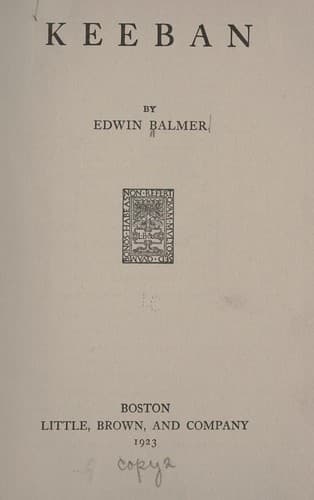
Adventure stories; Brothers -- Fiction; Chicago (Ill.) -- Fiction; Detective and mystery stories
I didn’t want Dibley to have any chance to oversee the fact that this
trip was a last inspiration of mine. I immersed myself, ostensibly, in
cost estimates of our new can and bottling plant which I happened to
have in my pocket, while I felt myself sinking deeper and deeper into
this game I’d entered with Cleopatra Doris Janvier.
XV
IN WHICH I ASSIST A GET-AWAY.
She came into my car, blithe and smiling; at least she smiled at me.
Every one looked up and every one, seeing that smile for me, put me
down as lucky, I know. When she was past and out of the car, I could
feel them gazing at me and wondering what I’d done to deserve such a
smile.
She was a gay, delightful maid. Suppose that, not having had the
advantage of acquaintance at the Flamingo Feather, I had met her in an
ordinary way. I’d have been mad over that girl. Heaven salvage my soul,
I was anyway.
She had a trick of playing up to me, which probably she used with
everybody, but I never really saw it except with me. Anyway, she did
it with me; and nobody else ever did. It was her trick of looking
up quickly, when I was about to say something, and smiling in that
pleasant way of hers (pleasant doesn’t half do it; but it has to go at
that) as if she was always sure of something good every time I talked
and as if she liked my line and me. When you’re decidedly slow and
ordinary, that makes quite a hit.
I sat figuring out her life. Put her down as twenty-two; then she was
born during the year Janvier was out after his first term in the “long
house” and while he was busy engraving the plates which sent him in
again. Some one--she hadn’t said who--took her into the country for ten
years. Maybe she had a mother then; maybe not; her mother had dropped
out somewhere. She was about twelve, then, when her father got out
again and began his famous “living Cleveland” series of engravings.
Twelve, they say, is the child’s most impressionable age; the parent or
guardian molds the future then.
Now I knew nothing about the guardian, when the parent was in the “long
house,” but I had considerable information about father; and I could
imagine him emerging from the pen all filled with eagerness to be back
at his game of showing up the government engravers and of getting away
with what he’d tried twice.
Wally Bailey had given me a graphic glimpse of Janvier and his aim
which, from one point of view, was actually a pursuit of perfection.
What Wally suggested was that Janvier wanted, more than anything else,
the satisfaction of doing the thing which had stumped him. That was
what he wanted his sight back for,--to have a go at it again. And here
he had it.
His daughter was helping him, naturally. She’d been born and bred to
his business and surely had caught something of the spirit of her
father who wouldn’t give in, in spite of three terms, till he’d shown
up the government.
Public-domain text, read in full here on John Shaqi.
Reviews
Reviews
No reviews yet
Be the first to share your thoughts on this work.
Join the Discussion
Join the discussion
Sign in to leave a comment or review.
Sign InorCreate an account