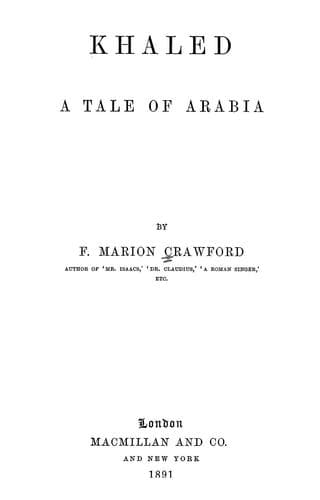
Khaled, A Tale of ArabiaCrawford, F. Marion (Francis Marion)
Science
Khaled, A Tale of Arabia
Crawford, F. Marion (Francis Marion)
Arabian Peninsula -- Fiction
'Truly,' he said to himself, 'this is a task beyond accomplishment,
which Allah has laid upon me. It is harder to get a woman's love than to
win kingdoms, and it is easier to destroy a whole army with one stroke
of a sword than to make a woman believe that which she does not desire.
And now the end is at hand. For she will never love me and I shall
certainly perish in this fight, being alone against so many. Allah
assuredly did not intend me to run away, and moreover there is no reason
left for remaining alive.'
On that day Khaled again called the chief men together in his kahwah,
and addressed them briefly.
'Men of Riad,' he said, 'I am aware that there is a conspiracy to
overthrow and destroy me, and I daresay that you yourselves are among
the plotters. I will not tell you who I am, but I swear by Allah that I
am neither a Persian nor a robber, nor yet a Shiyah. You will doubtless
attack me unawares, but you will not find me sleeping. I will kill as
many of you as I can, and afterwards I also shall undoubtedly be killed,
for I am alone and you have many thousands on your side. Min Allah--it
is in Allah's hands. Go in peace.'
So they departed, shaking their heads, but saying nothing.
CHAPTER X
The Sheikh of the beggars was an old man, blind from his childhood, but
otherwise strong and full of health, delighting in quarrels and swift to
handle his staff. He had at first become a beggar, being still a young
man, for his father and mother had died without making provision for
him, and he had no brothers. As he boasted that he was of the pure blood
of the desert on both sides, the other beggars jeered at him in the
beginning, calling him Ibn el Sheikh in derision and sometimes stealing
his food from him. But he beat them mightily, the just and the unjust
together, since he could not see, and acquired great consideration
amongst them, after which he behaved generously, giving his share with
the rest for the common good, and something more. His companions learned
also that his story was true and that his blood was as good as any from
Ajman to El Kara, for a Bedouin of the same tribe as Abdullah, the
husband of Almasta, came to see him not less than once every year, and
called him brother and filled his sack with barley. This Bedouin was a
person of consideration, also, as the beggars saw from his having a mare
of his own, provided with a good saddle, and from his weapons. In the
course of time therefore the blind man grew great in the eyes of his
fellows, until they called him Sheikh respectfully, and waited on him
when he performed his ablutions, and he obtained over them a supremacy
as great as was Khaled's over the kingdom he governed. He was very wise
also, acquainted with the interpretation of dreams, and able to recite
various chapters of the Koran. It was even said that he was able to
distinguish a good man from a bad by the sound of his tread, though some
thought that he only heard the jingling of coins in the girdle, and
Public-domain text, read in full here on John Shaqi.
Reviews
Reviews
No reviews yet
Be the first to share your thoughts on this work.
Elsewhere in the archive
Join the Discussion
Join the discussion
Sign in to leave a comment or review.
Sign InorCreate an account