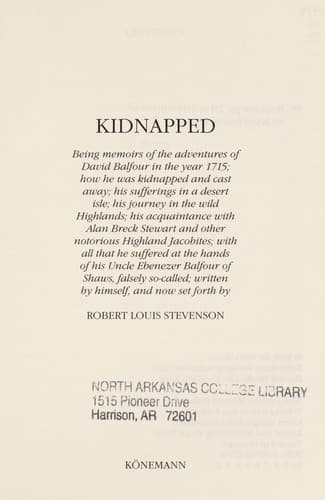
Adventure and adventurers -- Fiction; Historical fiction; Kidnapping -- Fiction; Scotland -- History -- 18th century -- Fiction
Among other good deeds that they did, they returned my money, which had
been shared among them; and though it was about a third short, I was
very glad to get it, and hoped great good from it in the land I was
going to. The ship was bound for the Carolinas; and you must not suppose
that I was going to that place merely as an exile. The trade was even
then much depressed; since that, and with the rebellion of the colonies
and the formation of the United States, it has, of course, come to
an end; but in those days of my youth, white men were still sold into
slavery on the plantations, and that was the destiny to which my wicked
uncle had condemned me.
The cabin-boy Ransome (from whom I had first heard of these atrocities)
came in at times from the round-house, where he berthed and served, now
nursing a bruised limb in silent agony, now raving against the cruelty
of Mr. Shuan. It made my heart bleed; but the men had a great respect
for the chief mate, who was, as they said, “the only seaman of the whole
jing-bang, and none such a bad man when he was sober.” Indeed, I found
there was a strange peculiarity about our two mates: that Mr. Riach was
sullen, unkind, and harsh when he was sober, and Mr. Shuan would not
hurt a fly except when he was drinking. I asked about the captain; but I
was told drink made no difference upon that man of iron.
I did my best in the small time allowed me to make some thing like a
man, or rather I should say something like a boy, of the poor creature,
Ransome. But his mind was scarce truly human. He could remember nothing
of the time before he came to sea; only that his father had made clocks,
and had a starling in the parlour, which could whistle “The North
Countrie;” all else had been blotted out in these years of hardship
and cruelties. He had a strange notion of the dry land, picked up from
sailor’s stories: that it was a place where lads were put to some kind
of slavery called a trade, and where apprentices were continually lashed
and clapped into foul prisons. In a town, he thought every second person
a decoy, and every third house a place in which seamen would be drugged
and murdered. To be sure, I would tell him how kindly I had myself been
used upon that dry land he was so much afraid of, and how well fed and
carefully taught both by my friends and my parents: and if he had been
recently hurt, he would weep bitterly and swear to run away; but if
he was in his usual crackbrain humour, or (still more) if he had had a
glass of spirits in the roundhouse, he would deride the notion.
Public-domain text, read in full here on John Shaqi.
Reviews
Reviews
No reviews yet
Be the first to share your thoughts on this work.
Join the Discussion
Join the discussion
Sign in to leave a comment or review.
Sign InorCreate an account