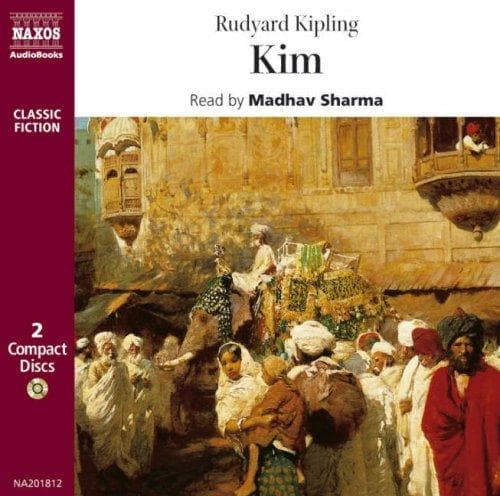
Adventure stories; Boys -- Fiction; India -- Fiction; Irish -- India -- Fiction; Lamas -- Fiction; Orphans -- Fiction; Spy stories
They met a troop of long-haired, strong-scented Sansis with baskets of
lizards and other unclean food on their backs, their lean dogs sniffing
at their heels. These people kept their own side of the road, moving at
a quick, furtive jog-trot, and all other castes gave them ample room;
for the Sansi is deep pollution. Behind them, walking wide and stiffly
across the strong shadows, the memory of his leg-irons still on him,
strode one newly released from the jail; his full stomach and shiny
skin to prove that the Government fed its prisoners better than most
honest men could feed themselves. Kim knew that walk well, and made
broad jest of it as they passed. Then an Akali, a wild-eyed,
wild-haired Sikh devotee in the blue-checked clothes of his faith, with
polished-steel quoits glistening on the cone of his tall blue turban,
stalked past, returning from a visit to one of the independent Sikh
States, where he had been singing the ancient glories of the Khalsa to
College-trained princelings in top-boots and white-cord breeches. Kim
was careful not to irritate that man; for the Akali’s temper is short
and his arm quick. Here and there they met or were overtaken by the
gaily dressed crowds of whole villages turning out to some local fair;
the women, with their babes on their hips, walking behind the men, the
older boys prancing on sticks of sugar-cane, dragging rude brass models
of locomotives such as they sell for a halfpenny, or flashing the sun
into the eyes of their betters from cheap toy mirrors. One could see at
a glance what each had bought; and if there were any doubt it needed
only to watch the wives comparing, brown arm against brown arm, the
newly purchased dull glass bracelets that come from the North-West.
These merry-makers stepped slowly, calling one to the other and
stopping to haggle with sweetmeat-sellers, or to make a prayer before
one of the wayside shrines—sometimes Hindu, sometimes Mussalman—which
the low-caste of both creeds share with beautiful impartiality. A solid
line of blue, rising and falling like the back of a caterpillar in
haste, would swing up through the quivering dust and trot past to a
chorus of quick cackling. That was a gang of _changars_—the women who
have taken all the embankments of all the Northern railways under their
charge—a flat-footed, big-bosomed, strong-limbed, blue-petticoated clan
of earth-carriers, hurrying north on news of a job, and wasting no time
by the road. They belong to the caste whose men do not count, and they
walked with squared elbows, swinging hips, and heads on high, as suits
women who carry heavy weights. A little later a marriage procession
would strike into the Grand Trunk with music and shoutings, and a smell
of marigold and jasmine stronger even than the reek of the dust. One
could see the bride’s litter, a blur of red and tinsel, staggering
through the haze, while the bridegroom’s bewreathed pony turned aside
to snatch a mouthful from a passing fodder-cart. Then Kim would join
Public-domain text, read in full here on John Shaqi.
Reviews
Reviews
No reviews yet
Be the first to share your thoughts on this work.
Join the Discussion
Join the discussion
Sign in to leave a comment or review.
Sign InorCreate an account