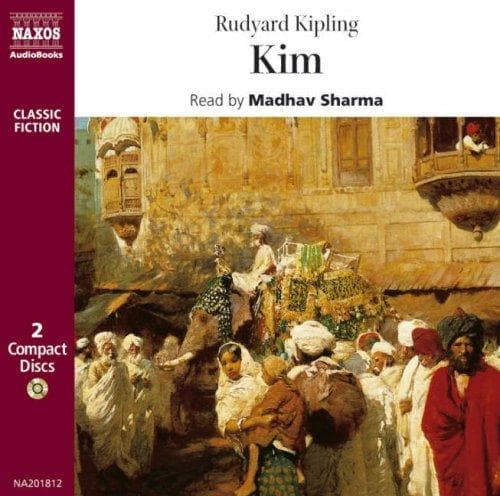
Adventure stories; Boys -- Fiction; India -- Fiction; Irish -- India -- Fiction; Lamas -- Fiction; Orphans -- Fiction; Spy stories
“These be the sort”—she took a fine judicial tone, and stuffed her
mouth with _pan_—“These be the sort to oversee justice. They know the
land and the customs of the land. The others, all new from Europe,
suckled by white women and learning our tongues from books, are worse
than the pestilence. They do harm to Kings.” Then she told a long, long
tale to the world at large, of an ignorant young policeman who had
disturbed some small Hill Rajah, a ninth cousin of her own, in the
matter of a trivial land-case, winding up with a quotation from a work
by no means devotional.
Then her mood changed, and she bade one of the escort ask whether the
lama would walk alongside and discuss matters of religion. So Kim
dropped back into the dust and returned to his sugar-cane. For an hour
or more the lama’s tam-o’shanter showed like a moon through the haze;
and, from all he heard, Kim gathered that the old woman wept. One of
the Ooryas half apologized for his rudeness overnight, saying that he
had never known his mistress of so bland a temper, and he ascribed it
to the presence of the strange priest. Personally, he believed in
Brahmins, though, like all natives, he was acutely aware of their
cunning and their greed. Still, when Brahmins but irritated with
begging demands the mother of his master’s wife, and when she sent them
away so angry that they cursed the whole retinue (which was the real
reason of the second off-side bullock going lame, and of the pole
breaking the night before), he was prepared to accept any priest of any
other denomination in or out of India. To this Kim assented with wise
nods, and bade the Oorya observe that the lama took no money, and that
the cost of his and Kim’s food would be repaid a hundred times in the
good luck that would attend the caravan henceforward. He also told
stories of Lahore city, and sang a song or two which made the escort
laugh. As a town-mouse well acquainted with the latest songs by the
most fashionable composers—they are women for the most part—Kim had a
distinct advantage over men from a little fruit-village behind
Saharunpore, but he let that advantage be inferred.
At noon they turned aside to eat, and the meal was good, plentiful, and
well-served on plates of clean leaves, in decency, out of drift of the
dust. They gave the scraps to certain beggars, that all requirements
might be fulfilled, and sat down to a long, luxurious smoke. The old
lady had retreated behind her curtains, but mixed most freely in the
talk, her servants arguing with and contradicting her as servants do
throughout the East. She compared the cool and the pines of the Kangra
and Kulu hills with the dust and the mangoes of the South; she told a
tale of some old local Gods at the edge of her husband’s territory; she
roundly abused the tobacco which she was then smoking, reviled all
Brahmins, and speculated without reserve on the coming of many
grandsons.
CHAPTER V
Public-domain text, read in full here on John Shaqi.
Reviews
Reviews
No reviews yet
Be the first to share your thoughts on this work.
Join the Discussion
Join the discussion
Sign in to leave a comment or review.
Sign InorCreate an account