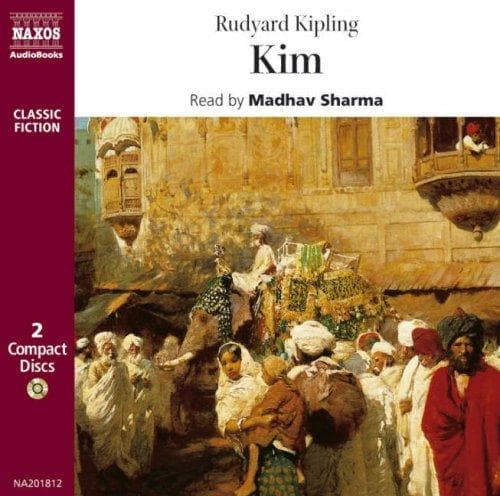
Adventure stories; Boys -- Fiction; India -- Fiction; Irish -- India -- Fiction; Lamas -- Fiction; Orphans -- Fiction; Spy stories
For the rest of the day Kim found himself an object of distinguished
consideration among a few hundred white men. The story of his
appearance in camp, the discovery of his parentage, and his prophecy,
had lost nothing in the telling. A big, shapeless white woman on a pile
of bedding asked him mysteriously whether he thought her husband would
come back from the war. Kim reflected gravely, and said that he would,
and the woman gave him food. In many respects, this big procession that
played music at intervals—this crowd that talked and laughed so
easily—resembled a festival in Lahore city. So far, there was no sign
of hard work, and he resolved to lend the spectacle his patronage. At
evening there came out to meet them bands of music, and played the
Mavericks into camp near Umballa railway station. That was an
interesting night. Men of other regiments came to visit the Mavericks.
The Mavericks went visiting on their own account. Their pickets hurried
forth to bring them back, met pickets of strange regiments on the same
duty; and, after a while, the bugles blew madly for more pickets with
officers to control the tumult. The Mavericks had a reputation for
liveliness to live up to. But they fell in on the platform next morning
in perfect shape and condition; and Kim, left behind with the sick,
women, and boys, found himself shouting farewells excitedly as the
trains drew away. Life as a Sahib was amusing so far; but he touched it
with a cautious hand. Then they marched him back in charge of a
drummer-boy to empty, lime-washed barracks, whose floors were covered
with rubbish and string and paper, and whose ceilings gave back his
lonely footfall. Native-fashion, he curled himself up on a stripped cot
and went to sleep. An angry man stumped down the veranda, woke him up,
and said he was a schoolmaster. This was enough for Kim, and he retired
into his shell. He could just puzzle out the various English Police
notices in Lahore city, because they affected his comfort; and among
the many guests of the woman who looked after him had been a queer
German who painted scenery for the Parsee travelling theatre. He told
Kim that he had been “on the barricades in “Forty-eight,” and
therefore—at least that was how it struck Kim—he would teach the boy to
write in return for food. Kim had been kicked as far as single letters,
but did not think well of them.
Public-domain text, read in full here on John Shaqi.
Reviews
Reviews
No reviews yet
Be the first to share your thoughts on this work.
Join the Discussion
Join the discussion
Sign in to leave a comment or review.
Sign InorCreate an account