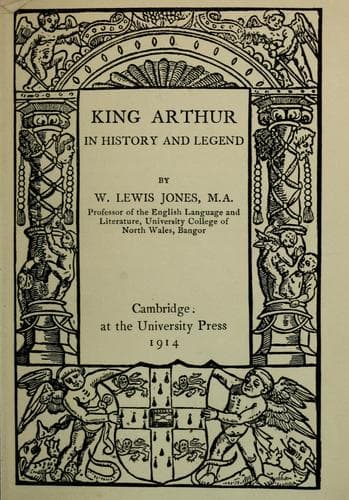
King Arthur in history and legendJones, William Lewis
History
King Arthur in history and legend
Jones, William Lewis
Arthur, King; Arthurian romances -- History and criticism
They, however, who would rob us of a historical and a chivalric
King Arthur must, perforce, leave us an Arthur whose attributes
as a presumed pagan deity do not prevent the unsophisticated from
recognising in him an ideal prince of fairy-land. It is as such a
prince that he appears against the setting of “old,” but not altogether
“unhappy, far-off things, and battles long ago,” in which he is
presented in the early literature of Wales. It is as such a prince that
one, at least, of the great English poets accepts him. To Spenser,
Arthur, “taken from mother’s pap” and
“straight deliver’d to a Faery knight
To be upbrought in gentle thewes and martiall might,”[65]
was just the potent deliverer required to bring the Red Cross
Knight and the rest of that questing company out of their various
difficulties, and to establish, through a series of timely
interventions, his right to the hand of the Fairy Queen.
In both _Kulhwch and Olwen_ and _The Dream of Rhonabwy_, as also in the
Triads, we find frequent mention of Cornwall as a district with which
Arthur is intimately connected. It is to Cornwall that he retires to
rest after the hunting of the boar; and it is to Cornwall that Kai, at
the close of _The Dream of Rhonabwy_, bids all repair who “would follow
Arthur.” His home, and his court, there is at a place called Kelli, or
Gelli, Wic. In later Arthurian literature little, if anything, is heard
of Kelli Wic; Caerleon-upon-Usk displaces it altogether as the scene
of Arthur’s central court. But, with Geoffrey of Monmouth, two other
Cornish localities are brought into dramatic connection with Arthur’s
fortunes--viz., Tintagol, or Tintagel; and Dimilioc, or Damelioc. These
places are unheard of in the Welsh Arthurian tales, but, according to
Geoffrey, it was at Dimilioc that Uther besieged, and his men slew,
Gorlois; and it was this siege that enabled Uther, in the semblance
of Gorlois, to gain access to Igerne in her retreat at the castle of
Tintagel, and so to become the father of “the most renowned Arthur.” It
is a pity that no Cornish records have survived to throw some further
light upon these momentous events. It is, however, very unlikely that
Geoffrey would have incorporated them in his narrative, had there not
been, in Cornwall as in Wales, traditions long current which associated
the name of Arthur with some of the ancient strongholds of the country.
No less significant, as indicative of the existence of a separate
Cornish legend of Arthur, is that Geoffrey, with others, tells us that
the last and fatal battle with Medrod took place on the river Camel
in Cornwall. It is not, perhaps, easy to reconcile these traditions
with the theory that Arthur’s life and achievements were confined to
North Britain. But that theory is no less difficult to reconcile with
the abundance, and the ubiquity, of Arthurian place-names in all the
districts, except Ireland, that make up “the Celtic fringe.” “Only the
Public-domain text, read in full here on John Shaqi.
Reviews
Reviews
No reviews yet
Be the first to share your thoughts on this work.
Join the Discussion
Join the discussion
Sign in to leave a comment or review.
Sign InorCreate an account