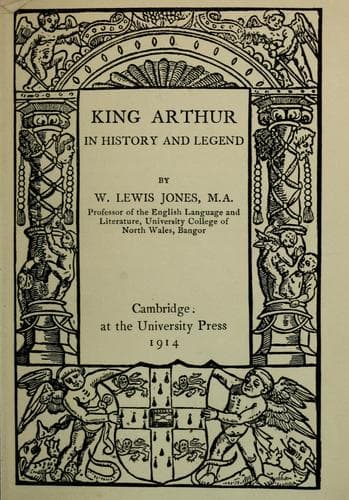
King Arthur in history and legendJones, William Lewis
History
King Arthur in history and legend
Jones, William Lewis
Arthur, King; Arthurian romances -- History and criticism
and Normandy at once suggests that he must have taken a considerable
interest in Welsh and Breton legendary lore. It is even possible that
it was at his instance that Walter, the archdeacon, and Geoffrey
embarked upon the quest which ultimately led to the discovery, real or
alleged, of the “book in the British tongue,” and to its translation
into Latin. It is obvious that Geoffrey, at any rate, was at pains to
produce a work which would please both his immediate patron and all
courtly readers who took pride in the growth of the Norman dominion.
A plausible, and by no means improbable, explanation of Geoffrey’s
motive in compiling the _Historia_ is that he meant it to be a kind
of “national epos,” blazoning the united glories of the composite
Anglo-Norman “empire” which reached the zenith of its power under
Henry II.[72] A book written with such a patriotic purpose would
certainly commend itself to Robert of Gloucester and other Norman
lords, and would appeal strongly to the imagination of less exalted
readers. The _History_ does, indeed, provide in Arthur a hero over
whose achievements Norman and Saxon, Welshman and Breton, could all
alike exult. Moreover, the common ancestry of the various constituent
races of the Angevin empire is shown by an account of their descent
from a branch of the great Trojan stock which founded imperial Rome.
Brutus, the son of Æneas, stands to Britain in the same relation as
Æneas himself stands to Rome, with the exception--and that was, of
course, to the advantage of Britain--that Brutus could be claimed as
the eponymous hero of this island.[73] Thus--as poets like Wace and
Layamon, and certain Welsh chroniclers, who use the name, were quick
to see--here was a _Brut_, which, though written in prose, had as
good a right to its epic title as the _Æneid_. There is, even, some
evidence that Geoffrey may, at one time, have cherished the ambition
of emulating Virgil himself by telling his story in verse; for, in the
eleventh chapter of his first book, we come across certain elegiac
lines which look uncommonly like fragments rescued from a projected
poem. Apart, however, from its account of the coming of Brutus, there
is little in Geoffrey’s _Brut_ that furnishes any real analogy with
the _Æneid_. It is not Brutus, but Arthur, who stands out as the hero
of the _Historia Regum Britanniæ_. The _Historia_ covers, altogether,
a period--according, of course, to the computation of its author--of
some fifteen hundred years; but more than a fifth part of it is devoted
to the record of Arthur’s life,--more than twice the space allotted to
the history of Brutus. It is upon the story of Arthur that Geoffrey
seems to concentrate all his powers, and, by magnifying the continental
conquests of the British king, he is able ultimately to point with
triumph to the fulfilment of a prophecy that “for the third time should
one of British race be born who should claim the empire of Rome.”
Public-domain text, read in full here on John Shaqi.
Reviews
Reviews
No reviews yet
Be the first to share your thoughts on this work.
Join the Discussion
Join the discussion
Sign in to leave a comment or review.
Sign InorCreate an account