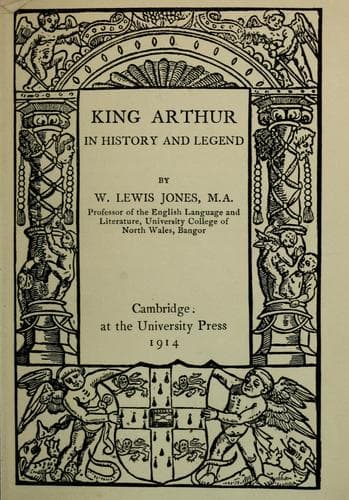
King Arthur in history and legendJones, William Lewis
History
King Arthur in history and legend
Jones, William Lewis
Arthur, King; Arthurian romances -- History and criticism
down to the fifteenth century, “the books that had been made about
Arthur over sea,” and in foreign tongues, far outnumbered those that
had been made in Britain. How are we to account for the popularity
which the Arthurian stories thus enjoyed on the European continent, and
for the way in which they became, during the Middle Ages, practically
international literary property?
These are the main questions which have to be answered to-day by
those who attempt to trace the origin and growth of the Arthurian
legends, and they are all suggested in Caxton’s preface. This little
book does not pretend to furnish a final answer to any one of them.
It simply essays to present in a summary and, it is hoped, a clear
form the substance of what is told about King Arthur in history and
legend, together with a brief notice of the development of Arthurian
literature mainly in England. No attempt will be made to trace the many
ramifications of the subsidiary stories which have been grafted upon
the original Arthurian stock. Characters like Perceval, or Lancelot,
or Tristram, who figure so largely in the full-orbed Arthurian cycle,
could each easily be made the subject of a separate volume far
exceeding the dimensions of the present one. Here, attention will be
concentrated, as far as possible, upon the figure and the fortunes of
Arthur himself.
CHAPTER I
THE EARLIEST ARTHURIAN RECORDS
If, in Caxton’s words, “such a king called Arthur” ever lived in these
islands, he must have flourished during the period between the first
coming of the Saxons and the middle of the sixth century. So much, at
any rate, is clearly attested by the meagre historical records which
profess to recount his deeds. Nothing, however, can be found in these
records to warrant the belief that he ever became “king” of any part
of Britain. His achievements as a warrior alone are mentioned, and
all that we can gather besides from Welsh tradition only serves to
emphasise the fact that his renown among the British people rested
mainly upon his warlike prowess. His admission to the so-called “Celtic
pantheon,” and his gradual evolution in Celtic tradition as a great
mythological figure, are matters of purely speculative interest,
and cannot be taken into account in an attempt to answer our first
question--Who, and what, was the historical Arthur? In Welsh we read
of an “emperor” Arthur,[8] but this title, as we shall see, implies
nothing more than that he was a war-leader, or a commander-in-chief
of a group of more or less celebrated generals. His kingship, and his
state as the head of a great court, are entirely the creations of later
romance.[9]
Public-domain text, read in full here on John Shaqi.
Reviews
Reviews
No reviews yet
Be the first to share your thoughts on this work.
Join the Discussion
Join the discussion
Sign in to leave a comment or review.
Sign InorCreate an account