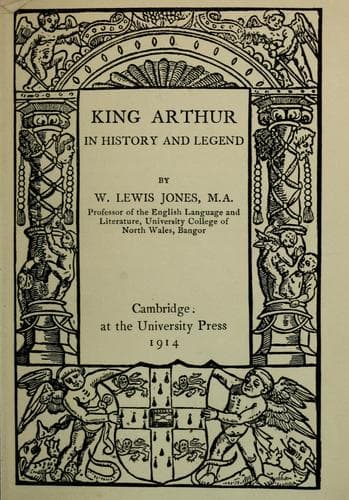
King Arthur in history and legendJones, William Lewis
History
King Arthur in history and legend
Jones, William Lewis
Arthur, King; Arthurian romances -- History and criticism
thus further emphasising the newly-discovered importance of early
British history. The same patriotic fervour accounts for the production
of such poems as William Warner’s _Albion’s England_ and Michael
Drayton’s _Polyolbion_. Warner is eminently practical, and, in his
reproduction of Geoffrey’s Arthurian narrative, leaves out its more
romantic incidents. Arthur’s
“Scottish, Irish, Almaine, French and Saxone battelles got
Yeeld fame sufficient: these seeme true, the reste I credite not.”
Drayton is inclined to trust Geoffrey more implicitly, and even takes
up the cudgels on his behalf against the critics who were then seeking
to disparage him. The “adversary says,” writes Drayton, that “Geoffrey
Monmouth first our Brutus did devise,” whereas the fact is that
“pregnantly we prove, ere that historian’s days,
A thousand-ling’ring years, our prophets clearly sung
The Britain-founding Brute.”[116]
Drayton’s poem, so largely topographical as it is in its character,
affords him many opportunities of making effective use of Arthurian
traditions. When he comes, for example, to the river Camel, he
remembers that Arthur was born as well as slain in that tract of
western country,
“As though no other place on Britain’s spacious earth
Were worthy of his end, but where he had his birth.”[117]
Again, referring to the songs of the ancient Britons, he tells us--much
in Geoffrey’s manner--of Caerleon with
“her temples and her groves,
Her palaces and walls, baths, theatres, and stoves.”
With all his garrulous “asides” and prosaic disquisitions, Drayton’s
_Polyolbion_ is a well-intentioned poem, and its sympathetic treatment
of the legends entitles it to an honoured place in the Arthurian
library. Like Caxton, Drayton bewails the indifference of British poets
to the wealth of native tradition which lay ready for their use, and
regrets that a British Homer had not been found to rise to “the height
of its great argument”;
“For some abundant brain, oh, there had been a story,
Beyond the blind man’s might to have enhanced our glory.”
Public-domain text, read in full here on John Shaqi.
Reviews
Reviews
No reviews yet
Be the first to share your thoughts on this work.
Elsewhere in the archive
Join the Discussion
Join the discussion
Sign in to leave a comment or review.
Sign InorCreate an account