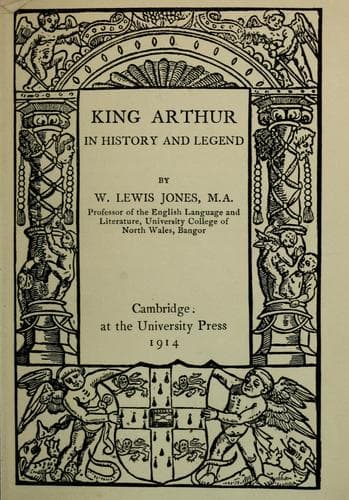
King Arthur in history and legendJones, William Lewis
History
King Arthur in history and legend
Jones, William Lewis
Arthur, King; Arthurian romances -- History and criticism
Although Elizabethan poets, from patriotic and courtly motives, were
so much interested in the early British legends as presented to them
by the English chroniclers of their time, it is somewhat strange that
these legends, and Arthurian story in particular, did not appeal
strongly to the imagination of the playwrights of our greatest
dramatic period. The only Arthurian drama of any consequence written
during the Elizabethan period was _The Misfortunes of Arthur_ by
Thomas Hughes, which was acted before the Queen in February 1588; and
the plot of that play is derived, in the main, not from Malory, but
from Geoffrey. In one important detail, however, Hughes departs from
Geoffrey’s narrative, and, like many of the later romancers, represents
Modred as Arthur’s son; and he is in touch with Malory in making the
tragedy of Arthur’s doom the nemesis that comes upon him for his sin.
The drama, as a whole, is a standard example of the Senecan type of
tragedy, so much in vogue at the time of its production, and action
and characterisation are altogether subordinated in it to narration.
Some life, however, is given to the characters of the two protagonists,
Arthur and Modred; and the introduction of the ghost of Gorlois at the
beginning and at the end of the play adds not a little to its general
dramatic effect. In his final speech the Ghost, exulting over the ruin
of the sinful house of Uther, is made to pay an adroit compliment to
Queen Elizabeth,
“That virtuous Virgo, born for Britain’s bliss,
That peerless branch of Brute,”
and gives utterance to the hope that she
“Shall of all wars compound eternal peace.”
We are still without a great English drama based upon a theme drawn
from Arthurian story; but what the Elizabethan dramatists, and most of
their successors, rejected as either too unreal or too intractable for
their purposes, continued even down to the Victorian age to haunt and
challenge the imagination of the poets.
“The mightiest chiefs of British song
Scorn’d not such legends to prolong”[118];
and yet we possess no great Arthurian epic in English verse any more
than a drama. Milton and Dryden both cherished the ambition of writing
one, but both, in different ways, found the pressure of circumstances
too strong for the accomplishment of their design. When Milton,
after the turmoil of the Civil Wars and his entanglement in public
controversy, once more turned his attention to poetry, he had need of
higher argument for his long-projected ‘heroic poem’ than
“to dissect
With long and tedious havoc fabl’d knights
In battles feign’d.”[119]
Arthurian memories, however, lingered with him to the last, for even in
_Paradise Regained_ he cannot help referring to what once charmed him
in stories
“Of fairy damsels met in forest wide
By knights of Logres, or of Lyones,
Lancelot, or Pelleas, or Pellenore.”
Public-domain text, read in full here on John Shaqi.
Reviews
Reviews
No reviews yet
Be the first to share your thoughts on this work.
Elsewhere in the archive
Join the Discussion
Join the discussion
Sign in to leave a comment or review.
Sign InorCreate an account