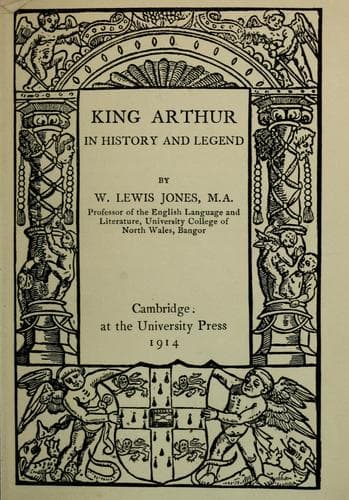
King Arthur in history and legendJones, William Lewis
History
King Arthur in history and legend
Jones, William Lewis
Arthur, King; Arthurian romances -- History and criticism
The Restoration age, despite its literary pre-occupation with ‘heroic’
plays and ‘heroic’ poetry, was unpropitious for the production of a
romantic epic worthy of the Arthurian, or any other similar theme. A
brave attempt, however, to achieve the impossible was made by “the City
Bard or Knight Physician,”[122] Sir Richard Blackmore, who in 1695
published _Prince Arthur, an Heroick Poem in Ten Books_, and followed
it up in 1697 with another ‘epic,’ in twelve books, called _King
Arthur_. These ponderous poems, written in heroic couplets, are really
political allegories, in which Arthur stands for the Prince of Orange,
and his Saxon enemy, Octa, for James the Second. But they aim at being
‘epics’ as well. Supernatural ‘machinery,’ evidently suggested in many
of its details by _Paradise Lost_, is introduced, and just as the gods
used to intervene in the struggles of the epic heroes of antiquity,
so angels like Uriel and Raphael watch over the fortunes of Arthur.
Indeed, the whole heavenly host befriends him, while Lucifer and the
rebel angels are the patrons of his foes. Blackmore, whatever else
may be said on his behalf, can claim to be at least faithful to the
tradition which represents Arthur as “the chief and best of the three
Christian kings,” for he makes him the supreme champion of Christendom
in his day:--
“This great deliverer shall Europa save,
Which haughty monarchs labour to enslave;
Then shall Religion rear her starry head,
And light divine through all the nations spread.”[123]
But, alas, who now reads Blackmore? The world generally is quite
content not to know him, and ready to echo Dryden’s pious wish--“peace
be to the _Manes_ of his Arthurs.”
Blackmore, grotesque and even ludicrous though his methods are of
allegorising the Arthurian stories, could, of course, claim high
poetical sanction for this particular use of them. Spenser had, long
before, “laboured to pourtraict in Arthure, before he was king, the
image of a brave knight, perfected in the twelve private morall
virtues, as Aristotle hath devised,”[124] and had also, though somewhat
obscurely, sought to “shadow forth” in him “a modern gentleman” of the
Elizabethan court,--the Earl of Leicester. There is not much to choose
between Leicester and William of Orange as “modern” types of Arthur,
but Spenser has, at least, succeeded in giving a romantic glamour to
his poem which helps us to forget its allegorical intent and takes us
back to the legendary Arthur’s native “land of faerie.” So, in _The
Faerie Queene_, Arthur appears in a rôle somewhat similar to that which
he plays in the romances as the helper and deliverer of sorely-beset
knights; and what the poet tells us about his person, his prowess,
and his accoutrements is, in spirit though not always in the letter,
quite in accord with romantic tradition. Delivered at birth to a faery
knight, “to be upbrought in gentle thewes and martiall might,” he was
put under the tutelage of Timon,[125]
Public-domain text, read in full here on John Shaqi.
Reviews
Reviews
No reviews yet
Be the first to share your thoughts on this work.
Elsewhere in the archive
Join the Discussion
Join the discussion
Sign in to leave a comment or review.
Sign InorCreate an account