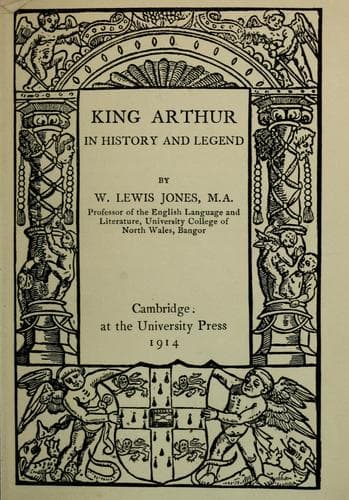
King Arthur in history and legendJones, William Lewis
History
King Arthur in history and legend
Jones, William Lewis
Arthur, King; Arthurian romances -- History and criticism
Tennyson’s King Arthur is certainly modern enough in sentiment and
speech, but the position which he holds in the ‘Idylls’ is, in many
ways, in harmony with that which he occupies in history and romantic
legend. Tennyson himself warns his readers that they must not expect to
find in the ‘Idylls’
“that gray king whose name, a ghost,
Streams like a cloud, man-shaped, from mountain peak,
And cleaves to cairn and cromlech still; or him
Of Geoffrey’s book, or him of Malleor’s.”
Rather they ought to discern in him
“Ideal manhood closed in real man.”
All the same, Tennyson’s pre-occupation with “ideal manhood” did not
prevent him from bestowing painful labour upon knowing the “real
man,” so far as the records, historical and romantic, reveal him; and
one of the outstanding features of _The Idylls of the King_ is their
remarkable fidelity to the details of Arthurian story as given in its
time-honoured literary sources. “Geoffrey’s book,” and “Malleor’s,” had
been carefully studied by the poet, and he had even been at pains to
garner all he could from early Welsh poetry and from the _Mabinogion_,
as presented in Lady Charlotte Guest’s charming translation. While
Malory is their main source, the ‘Idylls’ contain much that shows
how familiar Tennyson was with Arthurian lore generally in its most
primitive forms. The story of Geraint, for example, as told by him,
follows closely the Welsh version of it given by Lady Charlotte
Guest.[134] Again, the description of Britain in the opening lines
of _The Coming of Arthur_ as a country where each “petty king” was
ever waging war upon some other, and where the children “grew up to
wolf-like men, worse than the wolves,” until
“King Leodogran
Groan’d for the Roman legions here again,”
recalls vividly the bitter lamentations of Gildas over the degeneracy
of his countrymen. The account which Lancelot gives of Arthur’s wars in
_Lancelot and Elaine_ is an expansion of the record in Nennius of the
twelve Arthurian battles. And Tennyson’s general conception of Arthur
as the flower of kings who
“Drew all the petty princedoms under him,”
and “made a realm” in Britain, is far more in keeping with that of
the early chroniclers than with the picture given of him in the later
romances.
Public-domain text, read in full here on John Shaqi.
Reviews
Reviews
No reviews yet
Be the first to share your thoughts on this work.
Elsewhere in the archive
Join the Discussion
Join the discussion
Sign in to leave a comment or review.
Sign InorCreate an account