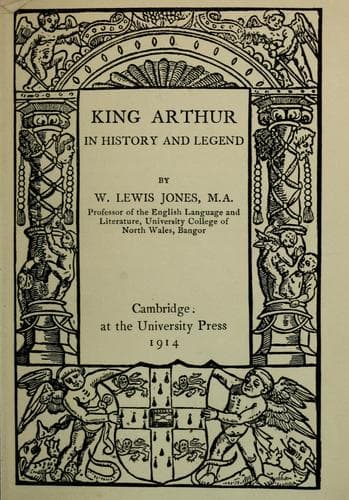
King Arthur in history and legendJones, William Lewis
History
King Arthur in history and legend
Jones, William Lewis
Arthur, King; Arthurian romances -- History and criticism
But it is not in such incidental features alone that the ‘Idylls’
are true to the older Arthurian tradition. Modern in their sentiment
and ethics though they may be, Tennyson’s main purpose in them of
“shadowing Sense at war with Soul” is not altogether unjustified by
the general literary history of the legends. Malory, at any rate, had
some such purpose, for Caxton assures us that the _Morte Darthur_
was “written for our doctrine, and for to beware that we fall not
to vice nor sin, but to exercise and follow virtue.” “In Malory’s
compilation, and in later mediæval romance, the fate of Arthur means
the fate of the chivalrous ideal, whose irreconcilable elements were
incorporated in him. In the romantic historians the fate of Arthur is
the fate of the Christian Britons in conflict with heathenism from
without and treason from within. Even in the old myths, his fate, if
we may trust Professor Rhys, is the fate of the culture-hero combined
with Father Sky, in conflict with the powers of Darkness and the
Nether-world. It was by a true inspiration that Tennyson was drawn to
the old legends, and reading into them his secret found it to be their
own. Accordingly, this identity of feeling with his predecessors kept
Tennyson on the track of the story.... Thus the ‘Idylls’ are both
truer to the authorities and nearer our own feelings than any other
of the adaptations of Arthurian story. Though the adventures are now
regarded from a modern point of view, this point of view is in the same
spiritual watch-tower from which the framers of the legend looked:
but it is the platform at the top, not a loop-hole on the winding
stair.”[135]
After all, however much the ‘Idylls’ may be cavilled at on the score of
their modern sentiment and occasional homiletic strain, their general
setting and atmosphere are genuinely romantic and in thorough keeping
with the far-off things of which they sing. Tennyson is true enough to
his sources in his descriptions of scenery and in his entire survey
of the traditional Arthurian country. “It is no land dwelt in by bold
bad men we see, when Arthur rides through the mountains and finds the
diamonds; when Geraint and Enid go through the green gloom of the
wood; when Galahad rides over the black swamp, leaping from bridge to
bridge till he sail to the spiritual city; when Lancelot drives through
the storm to the enchanted towers of Carbonek seven days across the
sea.”[136] In none of the ‘Idylls’ do we perhaps breathe more of the
atmosphere of pure romance than in the first and the last. Mystery and
magic surround both the coming and the passing of the King;
“From the great deep to the great deep he goes.”
This “weird rhyme” of Merlin’s comes into Bedivere’s memory as he sees
the barge with the three dark Queens bearing Arthur away into the
distance
“till the hull
Look’d one black dot against the verge of dawn.”
Public-domain text, read in full here on John Shaqi.
Reviews
Reviews
No reviews yet
Be the first to share your thoughts on this work.
Elsewhere in the archive
Join the Discussion
Join the discussion
Sign in to leave a comment or review.
Sign InorCreate an account