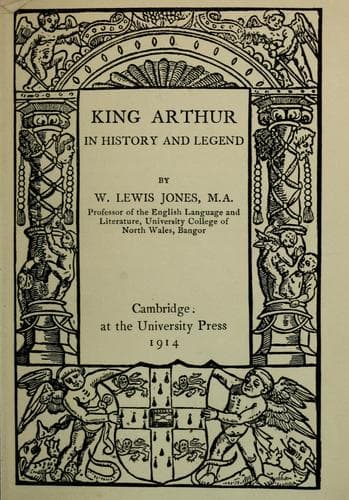
King Arthur in history and legendJones, William Lewis
History
King Arthur in history and legend
Jones, William Lewis
Arthur, King; Arthurian romances -- History and criticism
Uther Pendragon, 42, 57, 74, 122
Virgil, 68
_Vita Merlini_, 112
Vivien, 112
Vortigern, 30, 32, 69
Vortimer, 32
Wace, 58, 67, 85, 89
_Wales, The Four Ancient Books of_, 39, _seq._
Walter, archdeacon of Oxford, 68, 71, 83
Warinus, 33, 34
Warner, William, 86
Westminster, abbey of, 6
Weston, Miss J. L, 108, 109, 110
White Mount, The (in London), 53
_Wife of Bath’s Tale, The_, 117
William of Malmesbury, 2, 28, 31, 66, 71
William of Newburgh, 5, 28, 69, 86
William of Orange, 127
Winchester, 6, 97
Wolfram von Eschenbach, 107
Wordsworth, 20, 62, 86
Wygar, the smith, 92
Wynebgwrthucher, Arthur’s shield, 46
Yspaddaden (Pen Kawr), 26, 45, 50
PRINTED BY
TURNBULL AND SPEARS
EDINBURGH
FOOTNOTES:
[1] ‘The Songs of the Graves,’ in the twelfth century _Black Book of
Carmarthen_. “A grave there is for March (or Mark),”--so the lines
run,--“a grave for Gwythur, a grave for Gwgawn of the Ruddy Sword; a
mystery is the grave of Arthur”: or, as Sir John Rhys translates, “not
wise the thought--a grave for Arthur.”
[2] William of Malmesbury (_Gesta Reg. Angl._, Bk. III.), referring
to the discovery in Wales of the grave of Gawain, Arthur’s nephew,
speaks of the grave of Arthur himself as being unknown--hence, he says,
ancient songs (_antiquitas næniarum_) prophesy his return.
[3] The opening words of the Welsh romance, ‘Gereint, Son of Erbin.’
_Cf._ also the first sentences of ‘The Lady of the Fountain,’ as given
in Lady C. Guest’s _Mabinogion_.
[4] See Geoffrey’s _History_, Bk. IX. Ch. 12, in the excellent
translation by the late Dr Sebastian Evans (Temple Classics).
[5] The three great romantic “matters” are thus categorised in a
well-known passage in the _Chanson de Saisnes_ by the twelfth century
writer, Jean Bodel,--
“Ne sont que trois matières à nul home attendant,
De France et de Bretaigne et de Rome la grant.”
[6] _Hist. Rerum Anglic._ Proemium (Chronicles of Stephen, etc., Rolls
Series, 1884-85).
[7] See note _A_ on p. 138.
[8] See a poem entitled ‘Gereint, Son of Erbin,’ in _The Black Book of
Carmarthen_, and several passages in the _Mabinogion_,--especially in
‘The Dream of Rhonabwy,’--which are referred to later on.
[9] It is worth noting, by the way, that the “Saeson,” or Saxons,
against whom he is presumed to have fought most of his battles, are not
even mentioned in the Welsh Arthurian romances.
[10] The name _Artoria_ occurs is Tacitus, _Annals_, xv. 71; _Artorius_
in Juvenal, _Sat._, iii. 29. It was common enough in Rome.
Public-domain text, read in full here on John Shaqi.
Reviews
Reviews
No reviews yet
Be the first to share your thoughts on this work.
Elsewhere in the archive
Join the Discussion
Join the discussion
Sign in to leave a comment or review.
Sign InorCreate an account