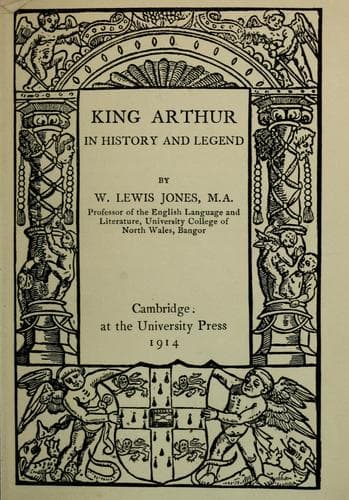
King Arthur in history and legendJones, William Lewis
History
King Arthur in history and legend
Jones, William Lewis
Arthur, King; Arthurian romances -- History and criticism
[11] Rhys, _Arthurian Legend_, p. 48. In Chap. I. of the same work Rhys
puts and answers the main question suggested in these pages as follows:
“How did Arthur become famous above other (Welsh, or British) heroes,
and how came he to be the subject of so much story and romance? The
answer, in short, which one has to give to this hard question must be
to the effect, that besides a historic Arthur there was a Brythonic
divinity named Arthur, after whom the man may have been called, or with
whose name his, in case it was of a different origin, may have become
identical in sound owing to an accident of speech” (_A. L._, p. 8).
[12] The chief authorities on Nennius are Mommsen (see his edition
of the _Historia_, and of Gildas, in _Mon. Germ. Hist._, Berlin,
1898), and Zimmer (_Nennius Vindicatus_, Berlin, 1893). See, also,
Fletcher (_The Arthurian Matter in the Chronicles_, Boston, 1906) and
M. R. James (_Camb. Hist. of Eng. Lit._, Vol. I. Ch. 5). Thurneysen
(_Zeitschr. f. Deutsche Philologie_, 1897) fixes 827 as the date of the
completion of the _History_.
[13] This date must be accepted if we are to believe Nennius’s
statement that he was a disciple of Elbodugus, or Elfodd, bishop of
Gwynedd.
[14] Chap. 56.
[15] _ipse dux erat bellorum._
[16] This is simply the Welsh (modern, _cad coed_) for “the battle of
Celidon Wood.”
[17] Rhys, _Arthurian Legend_, p. 7.
[18] _Arthurian Legend_, p. 7.
[19] A number of chieftains are styled _gwledig_ in the _Mabinogion_
(see index to edition of Welsh _Red Book_, text by Rhys and Evans, p.
342). Among them is one Amlawdd, or Amlodd, who in _Kulhwch and Olwen_
is the father of Goleuddydd, the mother of Kulhwch, “a boy of gentle
birth and cousin unto Arthur.” In a poem ascribed to Taliesin the deity
even is called _gwledig_--“gwledig nef a phob tud,” “ruler of heaven
and of every land.”
[20] Viz., to the tale, included in Lady C. Guest’s _Mabinogion_,
called ‘The Dream of Maxen Wledig.’ The glorification of Maxen, or
Maximus, in Welsh tradition suggests many points of analogy with the
story of Arthur.
[21] Lloyd, _Hist. of Wales_, Vol. I. p. 100.
[22] See the opening words of ‘The Lady of the Fountain,’ “Yr
amherawdyr Arthur oedd yng Kaer Llion ar Wysc.” See also _The Dream of
Rhonabwy_, _passim_.
[23] _Arthurian Legend_, p. 7. See also _The Welsh People_ (Rhys and
Jones), pp. 105 _sqq._
[24] The most elaborate and ingenious expositions of this theory will
be found in Skene’s _Four Ancient Books of Wales_, Vol. I. Chap. 4, and
Stuart-Glennie’s _Arthurian Localities in ‘Merlin’_ (Early Eng. Text
Soc., 1869).
[25] “Mons Badonicus” is still unidentified. Guest, in his _Origines_
_Celticæ_ (ii. 187-189) makes a brave attempt to prove that it was
Badbury in Dorset.
[26] _Hist. Reg. Brit._, Bk. IX. Ch. 4.
[27] _Ecclesiastical Sonnets_, i. 10.
[28] _Coming of Arthur._
[29] The translation is that of Dr H. Williams in his edition of Gildas
(Cymmrodorion Record Series, London, 1901), p. 63.
Public-domain text, read in full here on John Shaqi.
Reviews
Reviews
No reviews yet
Be the first to share your thoughts on this work.
Elsewhere in the archive
Join the Discussion
Join the discussion
Sign in to leave a comment or review.
Sign InorCreate an account