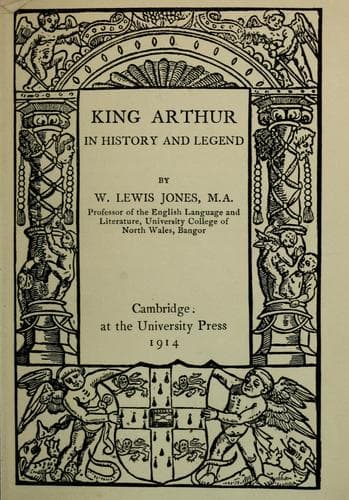
King Arthur in history and legendJones, William Lewis
History
King Arthur in history and legend
Jones, William Lewis
Arthur, King; Arthurian romances -- History and criticism
[58] _The Study of Celtic Literature._ Rhys’s opinion that the
primitive form, and substance, of this tale date from the tenth century
has been already referred to. Dr Gwenogvryn Evans, in the Preface to
his edition of _The White Book_ ‘_Mabinogion_,’ without assigning to
it so definite a date, holds that _Kulhwch and Olwen_ “is the oldest
in language, in matter, in simplicity of narrative, in primitive
atmosphere,” of all the tales to which the general name ‘mabinogion’
is given. Mr Alfred Nutt, while holding that portions of _Kulhwch and
Olwen_ are of “pre-historic antiquity, far transcending in age any
historic Arthur,” assigns the story in the form we have it to the
twelfth century, on the strength, mainly, of its affinities to eleventh
century Irish sagas.
[59] The Welsh name for “Excalibur.”
[60] Sir John Rhys does this in his _Celtic Folklore_ (Vol. II. pp.
512 _sqq._). See the whole of Chap. IX. in that work for a learned
discussion of the significance of the names, both local and personal,
in _Kulhwch_.
[61] Milton, _Paradise Lost_, ix. The prominence given to these
descriptions in the tale is emphasised by its brief epilogue. “And this
tale is called the _Dream of Rhonabwy_. And this is the reason that
no one knows the dream without a book, neither bard nor gifted seer;
because of the various colours that were upon the horses, and the many
wondrous colours of the arms and of the panoply, and of the precious
mantles and virtuous stones.”
[62] The Emperor (Lucius Hiberius, called in the Welsh narratives Llês)
is said by Geoffrey _(Hist. Reg. Brit._, X. xi) to have been killed by
“an unknown hand.”
[63] Rhys, _Arthurian Legend_, Ch. II.
[64] The most brilliant of these re-builders of “the Celtic Pantheon”
is Sir John Rhys. See, especially, his _Arthurian Legend_ and _Celtic
Heathendom_.
[65] Spenser, _Faerie Queene_, Bk. I. Canto 9.
[66] Dickinson, _King Arthur in Cornwall_ (Longmans), p. vi, where an
interesting account is given of Arthur’s Cornish associations.
[67] _Roman de Brut_, 1. 9994
[68] See above, p. 31.
[69] See the final chapter, on “Great Britain and Little Britain,” in
Rhys’s _Arthurian Legend_.
[70] _Ariegal and Elidure._
[71] _Hist. Reg. Brit._, Chap. I. (Dr Sebastian Evans’s translation).
I have used this translation for nearly all the extracts from Geoffrey
given in this chapter.
[72] This hypothesis is ingeniously elaborated by the late Dr Sebastian
Evans in the epilogue to his translation of Geoffrey (Temple Classics,
1903).
[73] This explanation of the name “Britain” is not, as has been pointed
out (pp. 60, 61), original to Geoffrey. It is his elaboration of the
Brutus legend that is significant.
Public-domain text, read in full here on John Shaqi.
Reviews
Reviews
No reviews yet
Be the first to share your thoughts on this work.
Elsewhere in the archive
Join the Discussion
Join the discussion
Sign in to leave a comment or review.
Sign InorCreate an account