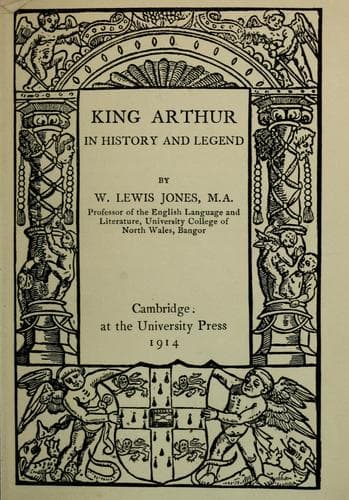
King Arthur in history and legendJones, William Lewis
History
King Arthur in history and legend
Jones, William Lewis
Arthur, King; Arthurian romances -- History and criticism
[86] Hueil, and the cause of his quarrel with Arthur, are incidentally
mentioned in _Kulhwch and Olwen_. Hueil, we there read, had stabbed his
sister’s son Gwydre, “and hatred was between Hueil and Arthur because
of the wound.”
[87] Rhys, who doubts Caradoc’s authorship of the _Life of Gildas_, is
“certain that the story” of Melwas “is ancient, for Chrétien de Troyes
in his _Erec_ speaks of Maheloas as the Lord of the Glass Island--‘Li
sire de l’isle de voirre.’” _Arthurian Legend_, p. 52.
[88] Layamon’s _Brut_, ll. 42, 43.
[89] The question of the mythological origin of the Round Table is
one of the many indeterminate problems of Arthurian “criticism.”
For a suggestive study of the question see Brown, _The Round Table
before Wace_ (_Harvard Studies and Notes_, Vol. VII., 1900), where he
confidently states that “the Round Table was a very early Pan-Celtic
institution.”
[90] _Brut_, ll. 19,254 _sqq._ (Madden’s edition).
[91] ll. 28,610 _sqq._
[92] ll. 22,910 _sqq._
[93] See note _C_ on p. 138.
[94] Camelot is, apparently, first heard of in Chrétien de Troyes’
_Chevalier de la Charrette_.
[95] Tennyson, _Merlin and Vivien_.
[96] See note _D_ on p. 138.
[97] So much has been clearly proved in the case of _Peredur_, for
instance, in a French essay on the composition of that romance recently
published from Paris by Dr Mary Williams, formerly Fellow of the
University of Wales.
[98] This, of course, is an obvious variant of the story told in the
_Life of Gildas_, already mentioned, of Guinevere’s abduction by Melwas.
[99] _Nonne Prestes Tale_, l. 392.
[100] See note _E_ on p. 139.
[101] Matthew Arnold, _Tristram and Iseult_.
[102] Swinburne, _Tristram of Lyonesse_.
[103] M. Bédier, in his edition of Thomas’s _Tristan_, maintains that
the original of all the various versions of the story was a single poem
composed in England. This is a disputed point among scholars, but it is
generally agreed that the story is of British origin.
[104] See Tennyson, _The Passing of Arthur_.
[105] A. Nutt, _The Legends of the Holy Grail_ (Popular Studies in
Mythology and Folklore), p. 72.
[106] For a learned and suggestive study of the various versions of
the Grail legend, see Miss J. L. Weston’s _The Legend of Sir Perceval_
(2 vols.) in the Grimm Library (Nutt). Miss Weston there distinguishes
three stages in the growth of the legend as “the Folklore, the
Literary and the Mystical.” In the Mystical, an element which she
holds to be “entirely foreign to the original tale,” viz., the Grail
quest, “modified and finally transformed it.” The folk-tale “assumed
an ecclesiastical and mystical character. The hero became a champion
of Christianity and Holy Church, and as such displayed the qualities
most approved by the religious views of the time: he became not merely
chaste, but an ascetic celibate, and any connection with women was
dropped altogether” (Vol. I. p. 117).
Public-domain text, read in full here on John Shaqi.
Reviews
Reviews
No reviews yet
Be the first to share your thoughts on this work.
Elsewhere in the archive
Join the Discussion
Join the discussion
Sign in to leave a comment or review.
Sign InorCreate an account