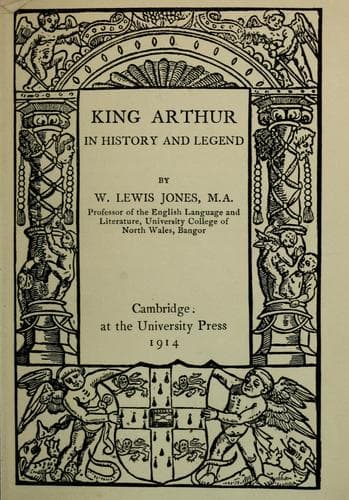
King Arthur in history and legendJones, William Lewis
History
King Arthur in history and legend
Jones, William Lewis
Arthur, King; Arthurian romances -- History and criticism
The oldest historical document in which Arthur is mentioned by name is
the famous _Historia Brittonum_ ascribed to Nennius. Parts of this work
may have been put together as early as the seventh century,[12] but the
compilation, as we now have it, was due to a Welshman named Nennius,
or (in Welsh) Nynniaw, who lived about the year 800.[13] The work may
be roughly divided into two parts,--the first, of sixty-six sections
or chapters, professing to give a cursory sketch of the history of
Britain from the earliest times down to the eighth century; the second
containing a list of the twenty-eight “cities of Britain,” together
with an account of certain “marvels” (_mirabilia_), or wonderful
natural phenomena, of Britain, which, the compiler tells us, he “wrote
as other scribes had done before him.” The quasi-historical part of the
work contains much the fullest notice of Arthur’s military exploits
to be found in any chronicle before that of Geoffrey of Monmouth,
while from sundry allusions to Arthur in the section on the ‘marvels
of Britain,’ we gather that legend was already busy with his name.
The celebrated passage in which Arthur is mentioned in the _Historia_
proper[14] runs as follows:--
“At that time, the Saxons increased and grew strong in Britain. After
the death of Hengist, Octha his son came from the northern part of the
kingdom to the men of Cantia, and from him are descended its kings.
Then Arthur fought against them in those days, together with the kings
of the Britons, but he himself was leader in the battles.[15] The first
battle was at the mouth of the river Glein; the second, third, fourth
and fifth on the river Dubglas, in the region Linnuis; the sixth on the
river Bassas; the seventh in the wood of Celidon, that is, Cat Coet
Celidon[16]; the eighth at the castle of Guinnion, when Arthur bore the
image of the holy Virgin Mary on his shoulders, and when the pagans
were put to flight and a great slaughter made of them through the might
of our Lord Jesus Christ and of Holy Mary his mother. The ninth battle
was fought at the city of Legion, the tenth on the shore of the river,
which is called Tribruit, and the eleventh on the mountain which is
called Agned. The twelfth battle was on Mount Badon, where there fell
nine hundred and sixty men before Arthur’s single onset; nor had any
one but himself alone a share in their downfall, and in all the battles
he was the victor. But the enemy, while they were overthrown in all
their battles, sought help from Germany, and continually increased in
number, and they brought kings from Germany to rule over those who were
in Britain up to the time of the reign of Ida, who was the first king
in Beornicia.”
Public-domain text, read in full here on John Shaqi.
Reviews
Reviews
No reviews yet
Be the first to share your thoughts on this work.
Join the Discussion
Join the discussion
Sign in to leave a comment or review.
Sign InorCreate an account