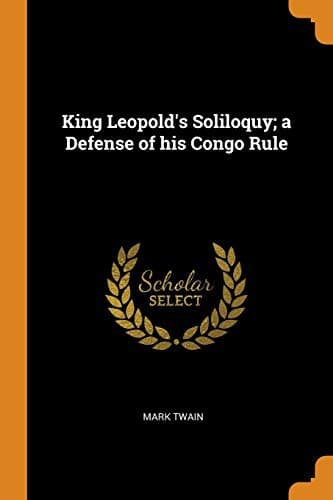
King Leopold's Soliloquy: A Defense of His Congo Rule — John Shaqi
King Leopold's Soliloquy: A Defense of His Congo RuleTwain, Mark
History
King Leopold's Soliloquy: A Defense of His Congo Rule
Twain, Mark
Congo (Democratic Republic); Léopold II, King of the Belgians, 1835-1909
One thing the report omits to do. It does not brand or judge the system
out of which the foul breed of iniquities has sprung,—the king’s claim
to personal ownership of 800,000 square miles of territory, with all
their products, and his employment of savage hordes to realize on his
claim. Judgment of this policy the Commission holds to be beyond its
function. Being thus disqualified for striking at the roots of the
enormity, the commissioners propose such superficial reforms as occur to
them. And the king hastens to take up with their suggestion by calling
to his assistance in the work of reform a new Commission. Of this body
of fourteen members all but two are committed by their past record to
defense and maintenance of the king’s Congo policy.
So ends the king’s investigation of himself; doubtless less jubilantly
than he had planned, but withal as ineffectively as it was foredoomed to
end. One stage is achieved. The next in order is action by the Powers
responsible for the existence of the Congo State. The United States is
one of these. Such procedure is advocated in petitions to the President
and Congress, signed by John Wanamaker, Lyman Abbott, Henry Van Dyke,
David Starr Jordan and many other leading citizens. If ever the
sisterhood of civilized nations have just occasion to go up to the Hague
or some other accessible meeting place, a foreordained hour for their
assembling has now struck.
SOME THINGS THE REPORT OF THE KING’S COMMISSION SAYS.
“Apart from the rough plantations which barely suffice to feed the
natives themselves and to supply the stations, all the fruits of the
soil are considered as the property of the State or of the
concessionaire societies.... It has even been admitted that on the land
occupied by them the natives cannot dispose of the produce of the soil
except to the extent in which they did so before the constitution of the
State.”
“Each official in charge of a Station, or agent in charge of a factory,
claimed from the natives, without asking himself on what grounds, the
most divers imposts in labor or in kind, either to satisfy his own needs
and those of his Station, or to exploit the riches of the Domaine....
The agents themselves regulated the tax and saw to its collection and
had a direct interest in increasing its amount, since they received
proportional bonuses on the produce thus collected.”
“Missionaries, both Catholic and Protestant, whom we heard at
Leopoldville, were unanimous in accentuating the general wretchedness
existing in the region. One of them said that “this system which compels
the natives to feed 3000 workmen at Leopoldville, will, if continued for
another five years, wipe out the population of the district.”
“Judicial officials have informed us of the sorry consequences of the
porterage system; it exhausts the unfortunate people subjected to it,
and threatens them with partial destruction.”
Public-domain text, read in full here on John Shaqi.
Reviews
Reviews
No reviews yet
Be the first to share your thoughts on this work.
Join the Discussion
Join the discussion
Sign in to leave a comment or review.
Sign InorCreate an account