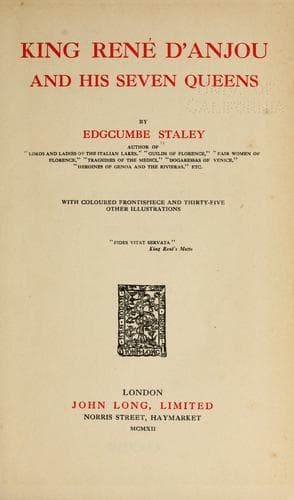
King René d'Anjou and His Seven QueensStaley, Edgcumbe
History
King René d'Anjou and His Seven Queens
Staley, Edgcumbe
France -- Court and courtiers; René I, King of Naples and Jerusalem, 1409-1480
A year’s captivity and cruelty, harsh and revolting, found the
spotless, unselfish, and pious “Maid of Orléans” in her twentieth
year--alas! so young to die--a human wreck; but, mercifully, an end
was put to her sufferings at Rouen on May 30, 1431. Burnt to death
in the market-place,--calling upon Jesus, Mary, Michael, Catherine,
and Margaret,--her fiendish murderers hardly allowed the fire to cool
before they raked up her poor grey ashes, and then cast them with
maledictions into the swirling Seine. So perished Jeanne d’Arc, the
child of God, the deliverer of her country. Now her place is among the
saints: she is St. Jeanne d’Arc.
It was said that her heart was found intact after the fire had burnt
itself out, and that as one stooped to pick it up a white dove
fluttered before his face!
Ill news travels apace. René de Bar et Lorraine heard of the tragedy
at Rouen, and was broken-hearted. He dismissed his captains, his
courtiers, and his minstrels, and shut himself up in his castle at
Clermont, where he chided his soul with tears and fastings. His was the
bitter cry: “_Ma Royne blanche, Jeanne, est mort--helas! ma Royne est
mort!_”
The heart, too, of Charles, the King, reproached him before he died; he
could never really have forgotten La Pucelle. A little girl was born to
him and Queen Marie six months after Jeanne’s martyrdom; her name was
“_Jeanne_,” as he said, “_en reconnaissance et pour mes péchés_.”
In the Register of Taxes the space against Domremy was left vacant
until the great revolution, except for the entry: “_Néant, à cause de
la Pucelle_.” Her parents’ cottage is still preserved, although the
Bois Chènus is no more. The memory of Jeanne d’Arc will never die.
CHAPTER VI
MARIE D’ANJOU--“LA PETITE REINE DE BOURGES”
I.
“The little Queen of Bourges,”--so called partly in derision, partly
in pity,--but all the same one of the noblest and best Queens who
ever shared the sovereign throne of France: “noble,” not so much in
gradation of rank as in distinction of character; “best,” or “good,”
not in the sense of mock righteousness, but in the interpretation of
whole-heartedness.
Marie d’Anjou was the eldest daughter of King Louis II. and Queen
Yolande of Sicily-Anjou-Naples-Provence. Born at Angers, October
14, 1404, she and her younger brother, René, four years her junior,
grew up to love one another almost distractedly. So intense was this
fraternal affection that their solicitous and resourceful mother viewed
it with apprehension, fearing its consequences,--if left unchecked or
undiverted into a more natural channel,--the cloister. It was no part
of the excellent training the Queen provided for her offspring to hide
their futures under the garb of religion; she had lofty ambitions for
all her children, and those ambitions she lived to see realized.
[Illustration: MARIE D’ANJOU
From a Painting of the School of Jean Fouquet (1460). National Gallery,
London
_To face page 174_]
Public-domain text, read in full here on John Shaqi.
Reviews
Reviews
No reviews yet
Be the first to share your thoughts on this work.
Elsewhere in the archive
Join the Discussion
Join the discussion
Sign in to leave a comment or review.
Sign InorCreate an account