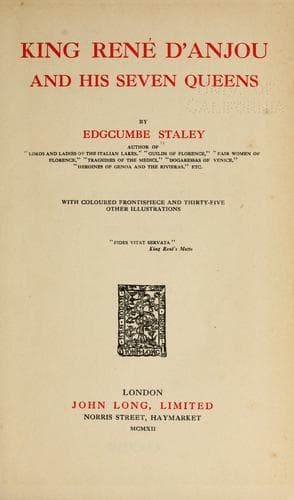
King René d'Anjou and His Seven QueensStaley, Edgcumbe
History
King René d'Anjou and His Seven Queens
Staley, Edgcumbe
France -- Court and courtiers; René I, King of Naples and Jerusalem, 1409-1480
Marie d’Anjou’s betrothal and marriage to Charles de Ponthieu,
Dauphin of France, in 1422, was a supreme master-stroke of statecraft
which only such a remarkable mother and Queen as Yolande of
Sicily-Anjou could effect. She, with all her prescience, could not have
forecast the future of France proper and her many sovereign sister
States, which was, in its happy fruition, due to that far-seeing
nuptial contract. Marie’s son, Louis XI., made France one nation much
as she is to-day.
When Queen Yolande so anxiously took charge of the young Dauphin, and
had him educated with her own children, she was quite prepared for
any mental and physical development in her son-in-law which might be
expected to result from his unhappy parentage. No doubt she did what
was possible to correct faults of heredity and to develop such latent
excellencies as had not been wholly vitiated in the child’s infancy.
Still, we may be sure she had a heart full of trouble as she witnessed
the degeneration of her son-in-law from paths of probity and virtue.
In truth, the marriage of Princess Marie was, in a strict sense, a
sacrifice and an oblation. The mating of her dearly loved daughter, a
girl of unusual promise, with a youth of evil ancestry and unworthy
predispositions must have cost the devoted mother much.
Marie was remarkable for rare beauty of person--pale, with perfect
features; tall, with a graceful figure, and distinguished by her regal
carriage.
In personal appearance Charles was unattractive: his figure was
insignificant and ill-formed; his head was unduly large; he had large
feet and hands, whilst his legs were short and bowed, and this caused
an ungraceful gait; his face was sickly-looking and pock-marked, with
a prominent nose, a wide and sensual mouth, and a heavy jaw; his
eyes were small and somewhat crisscross; he had coarse dark hair and
heavy eyebrows. If his destiny had not been a throne, he might just
as well have found his career in a stable. With all these personal
disadvantages, Charles was naturally warm-hearted and affectionate; he
was possessed of a cool judgment, very affable and considerate, and,
when roused, a very lion in the way. The marks of his evil mother’s
influence never left him; the crushing of his natural inclinations and
opportunities in childhood warped and unbalanced his mental calibre.
It was said scoffingly of him by those who were bereft of feeling: “_Le
Dauphin est un fou, fils d’un insensé et d’une prostituée_.”[A] Jean
Juvenal des Ursins perhaps went too far in the opposite direction, for
in 1433 he wrote in his “Chronicle” concerning the King: “_Sa vie est
plaisante à Dieu; il n’y-a-en aucun vice_.”[B]
[A] “The Dauphin is a poor fool, the son of a madman and a
prostitute.”
[B] “His manner of life is pleasant to God; he has no vice.”
Public-domain text, read in full here on John Shaqi.
Reviews
Reviews
No reviews yet
Be the first to share your thoughts on this work.
Elsewhere in the archive
Join the Discussion
Join the discussion
Sign in to leave a comment or review.
Sign InorCreate an account