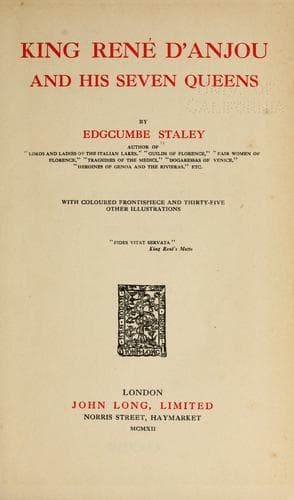
King René d'Anjou and His Seven QueensStaley, Edgcumbe
History
King René d'Anjou and His Seven Queens
Staley, Edgcumbe
France -- Court and courtiers; René I, King of Naples and Jerusalem, 1409-1480
The marriage of Charles, Count of Ponthieu, and Marie, Princess of
Sicily-Anjou, was solemnized at St. Martin at Tours, January 15, 1422.
It was a year of rejoicing in France, for on May Day her King by
descent, Charles VI., and her King by conquest, Henry V., entered Paris
riding side by side in a splendid triumph of peace. Charles’s reason
had returned to him with the return of happier days, and although the
spectre of Isabeau was beside him, he managed to retain his senses and
his vigour until October 21, when death mercifully heralded a new reign
and a new régime in Paris.
The Dauphin and Dauphine spent their short honeymoon at Loches and
Bourges, whence they were called to attend the Kings in Paris, and
there they remained till Charles VI. died. Thereafter troubles once
more devastated fair suffering France: the peace was broken, and a
broken band of fugitives fled the capital. The Court sought refuge at
Bourges.
“The King by misfortune in the warres grew so behindhand, both in fame
and estate, that amongst other afflictions hee was subject to reproach
and poverty, so that he dined in his small chamber attended only by his
household servants. Pothou and La Hire, coming to Châteaudun to ask for
succour, found him at table with no more than a rump of mutton and two
chickens. He had neither wine nor dessert, and only two attendants,
whilst his carriage had no relay of horses and only two grooms. He was
reproached for his love of fair Agnes (Sorel), but the Bishop of St.
Denis reported that hee loved her onely for her pleasing behaviour,
eloquent speech, and beauty; and that he never used any lascivious
action unto her, nor never touched her beneath the chin.”
The _Comptes de la Royne Marie_ record that the King and Queen were
reduced to eat their meals off common pewter dishes, that they had
little or no change of linen, and that the Queen sold all her jewels to
purchase food and other necessaries. The townsfolk of the neighbourhood
as well as the nobility contributed liberally to their Sovereigns’
wants. Jacques Cœur of Bourges in particular rendered them hospitality,
for he was accustomed to send in daily the royal supper at his own
expense. Cœur was a merchant, a jeweller, and a wine-grower, and waxed
rich in trade, but never wavered in his loyalty. He became Charles’s
treasurer, but after advancing him nearly 300,000 gold crowns, he was
for some unknown reason cast into prison and condemned to execution and
the confiscation of his goods. Queen Marie pleaded for their faithful
subject, and gained his reprieve, but Jacques Cœur never recovered his
liberty nor his property.
Public-domain text, read in full here on John Shaqi.
Reviews
Reviews
No reviews yet
Be the first to share your thoughts on this work.
Elsewhere in the archive
Join the Discussion
Join the discussion
Sign in to leave a comment or review.
Sign InorCreate an account