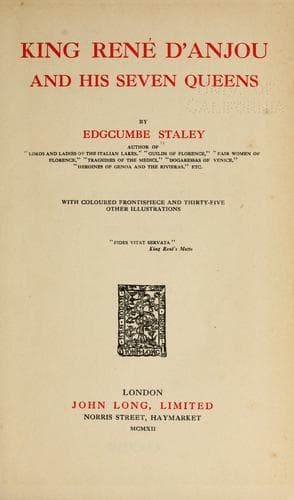
King René d'Anjou and His Seven QueensStaley, Edgcumbe
History
King René d'Anjou and His Seven Queens
Staley, Edgcumbe
France -- Court and courtiers; René I, King of Naples and Jerusalem, 1409-1480
Still, there were not wanting human touches which paint the
character of King Charles VI. in sympathetic colours. In the King’s
room at the Castle of Blois is a superb piece of tapestry, among many
others, embroidered with the “Story of the Seigneur and Châtelaine de
Courrages.” The “_Annales Français_” recount the following narrative:
“The Seigneur de Courrages was called upon by the Parliament of Paris
to fight in the ‘Lists’ with a certain Knight, Jehan Le Gris, for the
honour of his wife, the Dame de Courrages. During the absence of her
spouse in the Holy Land, the fair châtelaine gave her favours to an
urgent lover, the Seigneur Le Gris, and he made love to her, quite
naturally, in return. King Charles VI. was presiding at a tournament,
and he noted the presence of the lady in question, but was amazed at
her effrontery; for she was seated, superbly attired, in her state
chariot, in view of the whole assemblage, whereas the custom of the
time should have found her upon her knees in her closet, praying for
her good man. The King despatched a herald to the impudent hussy, with
a message that ‘it is inconceivable that anyone lying under so grievous
a reproach should assume herself to be innocent till such time as that
innocence shall have been made apparent.’ The brazen dame was ordered
at once to dismount from her carriage and retire to her _manoir_. She
was unwilling to bow to the royal command, and, hearing of this, the
King sent another messenger, who was instructed to conduct the fair
and frail delinquent beneath a scaffold, where she was ordered to cry
aloud to God for mercy, and to the King for clemency. In the issue
of arms, luckily for her, fortune favoured her husband, who unhorsed
his adversary, and, after pinning him to the ground with his sword,
compelled him to confess the villainies he had committed with his wife.
Then the unfortunate man was hurried off to the scaffold,--beneath
which Dame de Courrages was humbly kneeling,--and there and then hung
up by the neck by way of justification of his miserable sweetheart.”
What happened to the frail woman the chronicler has failed to tell;
probably the Seigneur de Courrages took his erring wife home and
administered a well-deserved flagellation in the privacy of his
bedchamber, and condemned her to a period of imprisonment in the family
dungeon upon a spare diet of bread and water! Such was the wholesome
discipline for marital infidelity in the days of chivalry!
Public-domain text, read in full here on John Shaqi.
Reviews
Reviews
No reviews yet
Be the first to share your thoughts on this work.
Elsewhere in the archive
Join the Discussion
Join the discussion
Sign in to leave a comment or review.
Sign InorCreate an account