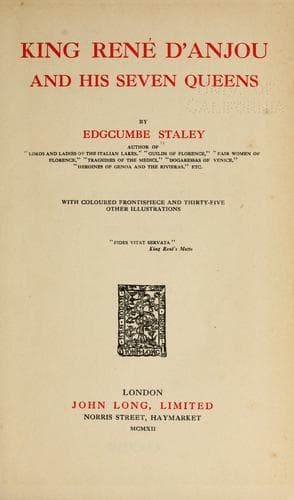
King René d'Anjou and His Seven QueensStaley, Edgcumbe
History
King René d'Anjou and His Seven Queens
Staley, Edgcumbe
France -- Court and courtiers; René I, King of Naples and Jerusalem, 1409-1480
Puzzling over the meaning of this strange verse, the ladies beheld
the Princess hastening to where they stood. With heightened colour
she asked them: “What are you doing here? Why are you not with the
Queen of Sicily?” Then effacing the writing with her foot, she added:
“I cannot think why I did not efface those words; I have committed an
indiscretion. But take note I did not name the unhappy person who wrote
them.” The romance went on unchecked. Dunois, still under age, very
adroitly contrived to remove the suspicions his conduct had aroused in
the mind of Queen Yolande, and Marie took dutifully and silently the
maternal reproofs. Then came the death of Charles VI., and Princess
Marie was proclaimed Queen of France. With more than a sigh,--almost a
broken heart,--she set herself to play her part as a virtuous woman and
as a loyal spouse. Dunois did not renounce his devotion to the Queen,
and she never forgot the love she had borne him--a Prince the very
antithesis of her husband, remarkable for personal beauty and mental
accomplishment, just the sort of man all women love. Daily she poured
out her soul before the altar of her private chapel for strength to be
true and faithful, and victory was hers; but it cost her dear.
“Car en vertueuse souffrance,
Au temps du commun desarroy,
Elle a monstre plus de vaillance
Que sage prince ou fier roy.”
“In point of virtuous suffering,
At times of deep alarms,
She exhibited more daring
Than wise prince or king in arms.”
This fascinating story of the loves of Count Dunois d’Orléans and
Princess Marie d’Anjou was worked up by fanatics into a culpable
liaison of the Queen. It grew in vile misrepresentation, and swelled
in garbled facts until it became abhorrent in the ears of all
decent-minded people. Some of Charles’s legitimate children were said
to have been fathered by the Count. The Queen very wisely refrained
from making replies to the evil stories, the only sensible way of
dealing with them. “Exempt,” as wrote Varillas, “not only from the
faults of the Court, but still more from suspicion that she had any
part therein, she had all the same to suffer from the poison of
calumny.” On the other hand, Marie suffered in patience the disdain and
unfaithfulness of the King, and returned his evil with her good. Her
entire life was a scene of sacrifice and an arena of benevolence.
Public-domain text, read in full here on John Shaqi.
Reviews
Reviews
No reviews yet
Be the first to share your thoughts on this work.
Elsewhere in the archive
Join the Discussion
Join the discussion
Sign in to leave a comment or review.
Sign InorCreate an account