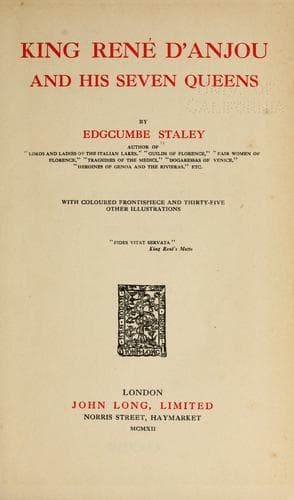
King René d'Anjou and His Seven QueensStaley, Edgcumbe
History
King René d'Anjou and His Seven Queens
Staley, Edgcumbe
France -- Court and courtiers; René I, King of Naples and Jerusalem, 1409-1480
Charles III., King of Naples, died in 1386, leaving to his son
Ladislaus the royal succession, with his widow, Queen Margaret, as
Regent. They with the Princess Giovanna, sixteen years of age, were
fugitives from castle to castle, pursued by the troops of Louis
d’Anjou. Nevertheless, Margaret was an astute mother, for when
Ladislaus was eighteen years old she espoused him to Constance,
daughter of the Count of Clermont in Sicily, a very wealthy heiress.
What matrimonial projects were hatched or addled on behalf of Princess
Giovanna during her father’s lifetime we know not, but almost the first
matter taken in hand by King Ladislaus was an advantageous marriage for
his sister. This was a very complicated business. First of all, neither
he nor she cared very much for matrimony; he was a libertine, and she
shared his freedom and his depravity. Next, each suitor for the hand
of Giovanna retired disgusted by the loose morals of the Neapolitan
Court and by the avarice of the King and his sister. However, at
length a match was arranged between the Princess and Prince William,
son of Leopold III., Duke of Austria. The actual nuptials, however,
were postponed for one reason or another until 1403, when Giovanna had
reached the considerable age of thirty-two. The princely couple went
off to Austria, where they remained more or less unhappy until 1406,
when the Prince died suddenly and suspiciously, many said by the hand
or direction of his ill-conditioned wife.
The widow returned at once to Naples to fill the place of honour
vacated by her brother’s wife, his second consort, Maria di Lusignan.
Queen Constance he had divorced in 1391, and married the daughter of
the King of Cyprus the same year. The ostensible reason for rejecting
Constance was the failure of her father to pay her dowry. She was a
lovely girl and virtuous,--a rare quality at that time,--and became
the idol of the Court. Queen Maria had scarcely been seated on the
throne, when she also fell from her high station. Ladislaus said she
was delicate and in consumption, and no wife for him. One day, when
she and the King were assisting at Mass in the cathedral, she heard
with the utmost astonishment and dismay the Archbishop read a Bull
of Pope Boniface IX. annulling her marriage with Ladislaus. At the
conclusion of the citation the prelate advanced to the Queen’s throne
and demanded her wedding-ring. Too stupefied to resist, the pledge of
her married state was torn from her finger, and she was carried away
to a remote convent under the care of two aged nuns. Three years after
this outrage the King relented of his cruelty, and married her to one
Andrea di Capua, one of his favourites. He took a third wife in 1406,
Marie d’Enghien, the widow of Raimondo d’Orsini, some six months after
the return of his sister from Austria. She is said to have survived
Ladislaus. Some letters of hers are preserved at Conversano, near Bari,
in the Benedictine convent.
Public-domain text, read in full here on John Shaqi.
Reviews
Reviews
No reviews yet
Be the first to share your thoughts on this work.
Elsewhere in the archive
Join the Discussion
Join the discussion
Sign in to leave a comment or review.
Sign InorCreate an account