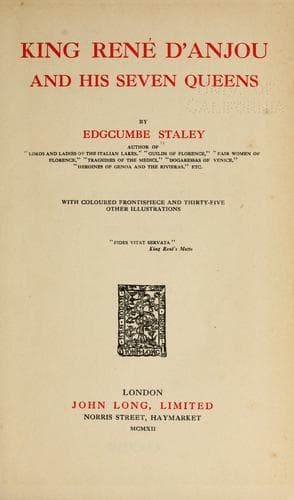
King René d'Anjou and His Seven QueensStaley, Edgcumbe
History
King René d'Anjou and His Seven Queens
Staley, Edgcumbe
France -- Court and courtiers; René I, King of Naples and Jerusalem, 1409-1480
The advance of Louis d’Anjou upon the capital roused Ladislaus to
action, and he hastily gathered together an undisciplined army, and
set forth to withstand his rival to the throne. A decisive battle was
fought at Rocca Secca, May 19, 1411, wherein Ladislaus’s troops were
routed, but Louis failed to follow up his advantage, and Ladislaus
retained his throne and continued his debauches.
Early in 1412 Queen Margaret, mother of the King and of Giovanna,
died somewhat suddenly. She and her entourage had taken refuge from
a visitation of plague, which spared neither prince nor peasant,
at her villa at Acquamela, six miles from Salerno. She was buried
privately in the Cathedral of Salerno, in the crypt over against the
marble sarcophagus which contained the ashes of St. Matthew. Whatever
influence she may have exerted during the youth of her son and daughter
for their good was speedily dissipated, and as soon as Ladislaus
had obtained the crown he took steps to circumscribe the liberty of
his mother. She appealed to her daughter Giovanna for sympathy, but
found none, and the poor old Queen, who had survived her consort,
Charles, for six-and-twenty years, was consigned to the Convent of the
Annunciation, “so as to be out of the way of mischief,” as her daughter
phrased it. The natural rôle of mother was entirely out of place in a
palace or at a Court ruled by a libertine and a prostitute.
Ladislaus died sadly and alone. His unnatural sister refused to be with
him, and all his butterfly courtesans gave to themselves wing when
sickness and death entered the royal palace. He died August 6, 1414,
leaving no lawful offspring by his three wives, but a numerous family
of natural children. No Salic Law governed the succession to the throne
in the kingdom of Naples, consequently Giovanna became Queen.
The widowed Queen Giovanna had not married again, although she counted
lovers by the score; but within a few months of her accession she took
steps to ally herself with a Prince who should be the handsomest and
wittiest of the time. This determination of Giovanna was noised abroad
all over the capitals and Courts of Europe, and forthwith a troop of
eligible suitors passed through the ports of Marseilles and Genoa, each
bent on taking the ribald Queen at her word. The romance reads like a
fairy tale, for each princeling and prince was put through his paces
to show his qualifications in person and in purse; for, desperately
wicked as she was, the Queen had a commercial sense, and her exchequer
stood sorely in need of replenishment. Taken for all in all, Juan
d’Arragona, son of King Ferdinand, was the champion of physical beauty,
knightly courtesy, and financial competence; but he was no more than
a precocious lad of seventeen, whilst the Queen was forty-five. A
matrimonial union was ruled to be impossible, and the pride of Aragon
would not suffer a scion of her royal house to become the plaything of
a lewd Queen.
Public-domain text, read in full here on John Shaqi.
Reviews
Reviews
No reviews yet
Be the first to share your thoughts on this work.
Elsewhere in the archive
Join the Discussion
Join the discussion
Sign in to leave a comment or review.
Sign InorCreate an account