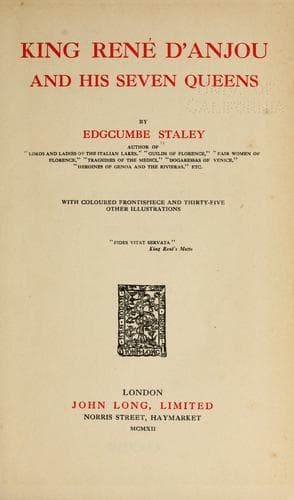
King René d'Anjou and His Seven QueensStaley, Edgcumbe
History
King René d'Anjou and His Seven Queens
Staley, Edgcumbe
France -- Court and courtiers; René I, King of Naples and Jerusalem, 1409-1480
Margaret was now _de facto_ and _de jure_ Queen of England and mistress
of her destiny--her husband’s, also. What a unique elevation it was
for a young girl of sixteen, all alone among strangers, rivals, and
adventurers! A false step seemed inevitable; indeed, absolute rectitude
and tactfulness of conduct under the exigeant circumstances which
surrounded her would have tried the grit of the stoutest mind and the
grasp of the strongest hand. Dubbed “_La Française_” by men and women
jealous of the King and of herself, she had to steer her course amid
endless pitfalls placed in her way. Warfare and politics were the two
chief contentions of the day. As for the first, she (Margaret) was its
mascot, and warriors laid down their arms at her feet; but with respect
to the wordy warfare of parties and their intrigues and plots the young
Queen danced upon the thinnest ice, and unconsciously she slipped.
She gave herself into the hands, quite naturally, of the party which
held first to the King and herself, as opposed to that which sought
initially self-interest. The Duke of Gloucester was the leader of the
loyal section of her lieges, and to him the young Queen turned for
light and leading.
Very soon the impress of Margaret’s strong character made itself felt
in every quarter. She spared neither the Duke of York himself, nor any
other rival to her own Lord and King; but what could a child still in
her teens do against the cabals of crafty and influential foes? Henry
was as weak as water; he hated political questions, caring very much
more, of course, for peaceful intercourse with his fascinating spouse,
and for the delights of leisure and learning, than for the turmoil of
Parliament and the vexed questions of the day. York held Henry in his
hand, but Margaret was a doughty nut to crack, and she kept him in his
proper place.
Letters written from Sheen and Windsor to Queen Isabelle by her loving
daughter show how happy was her state. Henry’s passionate love she
returned as passionately, and their loves made for peace both at home
and abroad. Literary pursuits and benevolent aims were in both their
minds: the King founded Eton College, and King’s College, Cambridge,
in 1446; the Queen, Queen’s College, Cambridge. Together they invited
Italian, French, and Flemish craftsmen to settle in England, and teach
their ignorant but not unwilling subjects some of the arts of peace.
The poor were relieved, the naked clothed, the hungry fed; but when all
estates of the realm seemed secure and in prosperity, the dark spectre
of sedition rose at the beck and call of the Duke of York. King Henry
had to rouse himself and lay low the insurrection of Jack Cade and
30,000 mislead Kentish men. This was the beginning of troubles.
II.
Public-domain text, read in full here on John Shaqi.
Reviews
Reviews
No reviews yet
Be the first to share your thoughts on this work.
Elsewhere in the archive
Join the Discussion
Join the discussion
Sign in to leave a comment or review.
Sign InorCreate an account