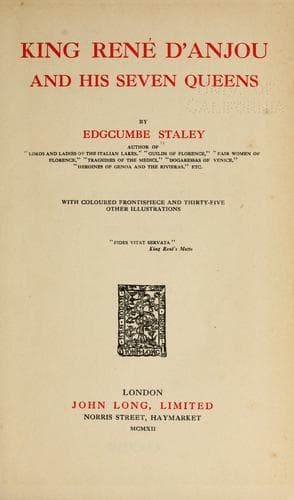
King René d'Anjou and His Seven QueensStaley, Edgcumbe
History
King René d'Anjou and His Seven Queens
Staley, Edgcumbe
France -- Court and courtiers; René I, King of Naples and Jerusalem, 1409-1480
For some little time Margaret had detected signs in her consort’s
speech and manner that caused her the gravest solicitude. She had
witnessed the mental depression and lassitude of her uncle, the King
of France, and she had grieved for her beloved aunt’s (Queen Marie’s)
anxieties. The insanity of King Charles VI., too, had been one of the
sad family histories of her school days in Anjou. Now she was faced
with a trouble far away more terrible than any of these. In 1453 the
King’s memory began to fail, he was bereft of feeling, and gradually he
lost his power of walking. The malady, indeed, had shown itself during
the Christmas revels at Greenwich. The Queen was already broken-hearted
by the news she received from France of the critical state of her
mother’s health, and when, on March 5, she heard of her death, poor
Margaret was indeed disconsolate. In pain she turned to Henry for
comfort, but he failed to comprehend her sorrow. All around were men
and women intriguing against herself and him; alone she had to bear her
trouble, and the trouble was intensified in pathos by the fact that she
was at last enceinte. Would her child be stillborn, she asked herself
many a time; how could she expect otherwise when so utterly cast down?
Then she realized the loneliness of a throne. The menace of the Duke
of York was a scourge to wear her down, and his denunciation of her
barrenness an unspeakable affront.
Crushed indeed she was, and yet she had to play the man; for she was
both King and Queen of England, and while she lived she determined
that none should sap her authority. Henry subsided into imbecility,
but Margaret’s will matched and vanquished York’s, although he was
proclaimed “Protector of the Realm and Church.” The year sped on, but
it brought joy to the sad heart of the lonely Queen, and the whole
nation shared her happiness. On October 11 she brought forth her
first-born child, a son and heir, a fact of the vastest importance for
all concerned, friend and foe. York at once denounced the child for a
changeling; but the nation would not have it so, and he was christened
Edward publicly at Westminster, and created Prince of Wales, so named
because his birthday was that of the holy King St. Edward.
Alas! the King could not be roused sufficiently to recognize his son,
nor, indeed, his wife, and this was construed by York and his party
as proof conclusive against the truth of the Queen’s accouchement. At
the same time they threw out insinuations against her character with
respect to relations with many prominent men of her entourage.
Public-domain text, read in full here on John Shaqi.
Reviews
Reviews
No reviews yet
Be the first to share your thoughts on this work.
Elsewhere in the archive
Join the Discussion
Join the discussion
Sign in to leave a comment or review.
Sign InorCreate an account