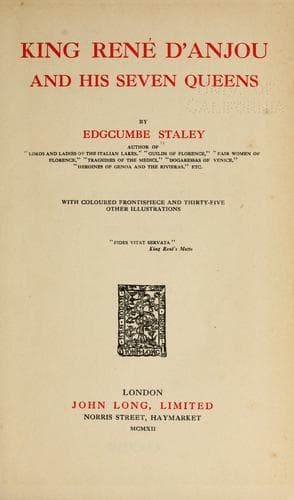
King René d'Anjou and His Seven QueensStaley, Edgcumbe
History
King René d'Anjou and His Seven Queens
Staley, Edgcumbe
France -- Court and courtiers; René I, King of Naples and Jerusalem, 1409-1480
Salisbury was also _hors de combat_, wounded and a prisoner, and by the
Queen’s orders he was beheaded on the field of battle,--for he would
not yield his sword and word,--and his head was placed by the side of
his leader’s. In a moment, too, of justifiable vengeance, the Queen
directed that space should be left on that carrion portal for two other
traitors’ heads--Warwick’s and March’s. “There,” she said, “they all
four shall dangle till the rain and the sun and the birds have consumed
them--warnings to all and sundry who shall hereafter raise voice and
hand against their liege.”
Margaret pushed south, and at St. Albans, on February 17, met Warwick,
with the King in his camp. The issue was soon decided; 2,000 Yorkists
were slain, and Henry and Margaret were united once more. Lord Montague
discovered him alone seated under a tree. Clifford galloped off to the
Queen to tell her the good news, and, bereft of kirtle and veil and
every sign of royalty, she rushed as she was to where the King was
awaiting her. He bade her kneel before he embraced her, and gave her
then and there the knightly accolade, as well as to his son, who had
run as hard as he could after his mother, and he also knighted sixty
worthy, loyal gentlemen. All entered the abbey church for _Te Deum_
and Benediction, and then the royal pair sought the monastery for rest
and food. Leaving Henry at his devotions, and the Prince to cheer him,
Margaret again mounted her charger and marched straight on London,
where York’s eldest son, Edward, Earl of March, a lad of eighteen,
had been proclaimed King as Edward IV. Perhaps over-confident, and at
all events uncompromising in her intention to punish the disloyal and
rebel citizens, she failed to post her army advantageously, although
she had 60,000 men against Warwick’s 40,000. At Towton the fates were
once more against her, and she, with the King and the Prince, fled for
their lives to Newcastle, and over the border to the friendly Court
of the Queen Regent, Margaret. Henry was established in royal state
at Kirkcudbright, and the Queen and Prince at Dunfermline, and there
the little fellow, just eight years of age, was betrothed to the young
King’s sister, Margaret.
Margaret was really happy in her new home, and, resourceful as she was
and never cast down, she turned her attention to peaceful pursuits, and
in particular interested herself in the local industry of wool-weaving.
She had seen her father’s and her mother’s interest, in her happy days
in Lorraine and Anjou, in the craftsmen and craftswomen about them,
and her own skilful fingers had busied themselves in homely, peaceful
avocations. Margaret endeared herself to her Fifeshire friends, as she
usually did to all who were fortunate enough to be thrown into contact
with her, and they sang of her:
“God bless Margaret of Anjou,
For she taught Dunfermline how to sew.”
Public-domain text, read in full here on John Shaqi.
Reviews
Reviews
No reviews yet
Be the first to share your thoughts on this work.
Elsewhere in the archive
Join the Discussion
Join the discussion
Sign in to leave a comment or review.
Sign InorCreate an account