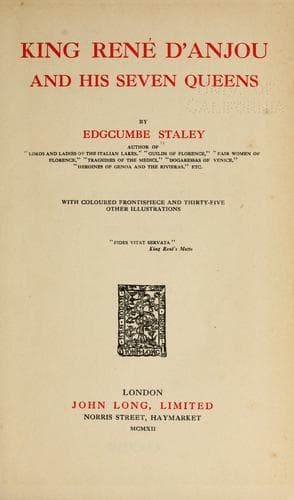
King René d'Anjou and His Seven QueensStaley, Edgcumbe
History
King René d'Anjou and His Seven Queens
Staley, Edgcumbe
France -- Court and courtiers; René I, King of Naples and Jerusalem, 1409-1480
It was said, too, of Margaret, that “if she had not been destined to
play the rôle of Bellona, she would have glorified that of Minerva.”
The Earl of March,--to whom she never allowed the style of Edward
IV.,--was wont to repeat his quaint joke: “Margaret is more to be
feared when a fugitive than all the leaders of Lancaster put together!”
On April 16, 1462, Queen Margaret bade adieu to her consort at
Kirkcudbright, and with her son and suite, in four well-found Scottish
galleys, set sail for France. She landed at Ecluse in Brittany, after
more perils on the sea, and was cordially welcomed by Duke Francis,
who gave her 12,000 _livres_. Thence she made straight to Chinon,--of
happy memories,--to interview King Louis, who had just been crowned at
Reims, upon the death of his father, Charles VII. There she was folded
in the loving arms of her dear aunt, Queen Marie; and what a meeting
that was for both royal ladies! They had not seen each other since that
auspicious wedding-day sixteen years before. Then they were both in
the heyday of prosperity; now both were crushed by Providence--Marie
flouted by her ill-conditioned, jealous daughter-in-law, Charlotte de
Savoy, now Queen-consort of France, and Margaret a fugitive!
Louis played a double game--a cruel one indeed, and insincere so
far as Margaret was concerned. He spoke to her fairly, but his mind
was with the usurping King of England. Under one pretext or another
he delayed his reply to her plea for assistance, but at length, in
desperation, Margaret pledged Jersey with him for 2,000 French bowmen.
King René was in Provence, but, taking a hint from Louis that his
presence would be undesirable just then in Anjou, he sent for his
daughter to join him at Aix. This was impossible; for Margaret time was
all too valuable, and she set sail for Scotland on October 10. With her
went a few single-hearted knights, but of all the hosts of admirers
and loyal followers of sixteen years before, only one of mark wore his
badge of chivalry consistently--the gallant and accomplished Pierre de
Brézé, a _preux chevalier_ indeed, the forerunner of Bayart, and like
him “_sans peur et sans reproche_.”
Again the elements were not only unpropitious, but malevolent. Escaping
the vigilance of Edward’s cruisers, and the rebel guns of Tynemouth,
basely trained upon their Queen, her ships were wrecked on Holy Island.
There 500 of her troops were massacred, and Margaret and de Brézé, and
a very meagre following, put to sea in a fisherman’s open boat which
landed them on Bamborough sands. The banner of Henry of Lancaster,
once more raised aloft by Margaret, magnet-like drew all the northern
counties, and in spite of Somerset’s desertion the Queen soon found
herself at the head of a formidable army, with the King beside her and
the Prince. Once more at Hexham fickle fortune failed the intrepid
Queen. Henry was again a captive, but Margaret and Edward made good
their escape over the Scottish border.
Public-domain text, read in full here on John Shaqi.
Reviews
Reviews
No reviews yet
Be the first to share your thoughts on this work.
Elsewhere in the archive
Join the Discussion
Join the discussion
Sign in to leave a comment or review.
Sign InorCreate an account