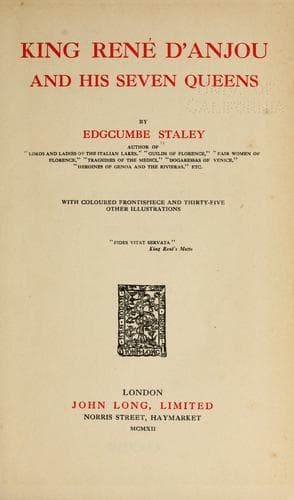
King René d'Anjou and His Seven QueensStaley, Edgcumbe
History
King René d'Anjou and His Seven Queens
Staley, Edgcumbe
France -- Court and courtiers; René I, King of Naples and Jerusalem, 1409-1480
Margaret was sent to the Tower, but not to her husband; they were kept
apart, and the Princess of Wales was delivered over to the care of her
uncle, the Archbishop of York. But even so Edward’s malice was not
exhausted. The Queen was conducted without honour, or even decency, in
the suite of Edward on his return to the capital. At Coventry,--of all
places for further outrage, a place so greatly agreeable to Henry and
herself,--ill-fated Margaret was subjected to personal insults from her
vanquisher. In reply she reviled him, and thrust him with abhorrence
from her. In revenge he ordered her to be fastened upon a common
sumpter horse, and he ordered a placard to be placed on her breast,
“This is Queen Margaret, good lieges,” and her hands were tied behind
her back. Thus was the most valiant, most unselfish, and most loyal
Queen that England ever had led to grace the mock triumph of a royal
murderer. She was thrust into the foulest dungeon of the grim Tower,
and there remained, bereft of food, of service, and wellnigh of reason,
too, for seven dreary, weary months.
The day after her incarceration King Henry’s dead body was discovered
in his cell. Gloucester, it was said, had killed him; but Edward was,
if not the actual murderer, privy to the deed. Queen Margaret, hearing
in her dark, foul den the heavy tramp of men-at-arms, scrambled up to
the bars of her little window, and beheld,--what probably Edward meant
she should,--the corpse of her slaughtered husband borne past for
burial. No ceremony of any kind accompanied that mournful passing. At
St. Paul’s, Henry’s body was exposed in a chapel of the crypt, and then
it found merciful sepulture in the God’s-acre at Chertsey Abbey.
That her beloved son,--her one and only hope,--was dead as well,
heart-broken Margaret gathered amid ribald blasphemies of the
intoxicated soldiery as she was borne to London in that “Triumph.”
Now was she bereft indeed, and nothing seemed so desirable as death;
indeed, she resigned herself, and prepared herself for execution at any
moment, at any savage hint of her consort’s supplanter on England’s
throne--accursed Edward! It was, however, not to be supposed that King
Louis of France or King René of Sicily-Anjou should silently condone
the unhalting cruelty of a bloodthirsty monarch, especially when the
person and the honour of a French Princess were at stake.
III.
Public-domain text, read in full here on John Shaqi.
Reviews
Reviews
No reviews yet
Be the first to share your thoughts on this work.
Elsewhere in the archive
Join the Discussion
Join the discussion
Sign in to leave a comment or review.
Sign InorCreate an account