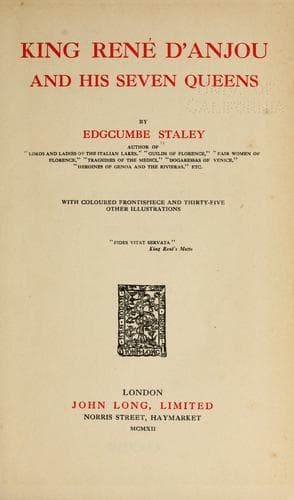
King René d'Anjou and His Seven QueensStaley, Edgcumbe
History
King René d'Anjou and His Seven Queens
Staley, Edgcumbe
France -- Court and courtiers; René I, King of Naples and Jerusalem, 1409-1480
Efforts were made, more or less feeble, for the delivery of the
incarcerated Queen by Louis,--fearful of offence to the Yorkist
King,--and by René, who had no resources with which to back up his
appeal. Anyhow, Margaret was, at the Christmas following the fatal
battle, released from durance vile, and consigned to the care of the
Duchess-Dowager of Somerset,--one of her earliest friends,--and went to
live under her wing at Wallingford. Edward made her the beggarly grant
of 5 marks weekly for the support of herself and two maid-servants!
There Margaret remained for five years, each one more intolerable than
its predecessor.
At the Peace of Picquigny, August 29, 1475, between Louis and Edward,
the latter agreed to accept a ransom of 50,000 gold crowns for the
widowed Queen. This compact was not an act of grace on the part of
Louis so much as a _quid pro quo_. He insisted upon René ceding
Provence to the crown of France, upon his death, by way of payment of
the ransom. Still, in this matter Edward was as good as his bond, and
directly the first instalment of the amount was paid in London to John
Howard, Edward’s Treasurer, Margaret was conducted to Sandwich, not
without indignity, and placed upon a common fishing-boat. Landing at
Dieppe, January 14, 1476, she was taken on to Rouen, where she received
the following affecting letter from her sorrowing father, King René:
“_Ma fille, que Dieu vous assiste dans vos conseils, car c’est rarement
des hommes qu’il faut en attendre dans les revers de fortune. Lorsque
vous désirerez moins ressentir vos peines, pensez aux miennes; elles sont
grandes, ma fille, et pourtant je vous console._”[A]
[A]“My child, may God assist thee in thy counsels, for rarely do
men render help in times of fortune’s reverses. When you desire
to resent your trials the least, think of mine; they are great,
my child, and therefore I wish to console you.”
True enough, the troubles and reverses of King René were more than
fall to the lot of most men of high culture and degree; but what of
Queen Margaret’s shipwreck? For nearly thirty years she had endured
experiences which had tried no other Queen half so hardly; and all
the while she had set a unique example of devotion, loyalty, courage,
and endurance, unexampled in history. There never was a truer wife, a
more self-sacrificing mother, a more intrepid and a nobler Queen, than
Margaret of Anjou.
From Rouen the Queen sent a message to King Louis, desiring to see
him; but he, knowing well her desperate case, and seeing no likelihood
of profit accruing to himself, coward-like, evaded an interview. His
miserable aunt might forage for herself, for all he cared, and go where
she listed, but not to Paris nor Amboise. With bent head and slow feet,
the great heroine of the Wars of the Roses, broken like a pitcher at a
fountain, took her lonely way no more in gallant cavalcade, but almost
in funereal cortège, to Anjou and Angers--the cradle of her race.
Public-domain text, read in full here on John Shaqi.
Reviews
Reviews
No reviews yet
Be the first to share your thoughts on this work.
Elsewhere in the archive
Join the Discussion
Join the discussion
Sign in to leave a comment or review.
Sign InorCreate an account