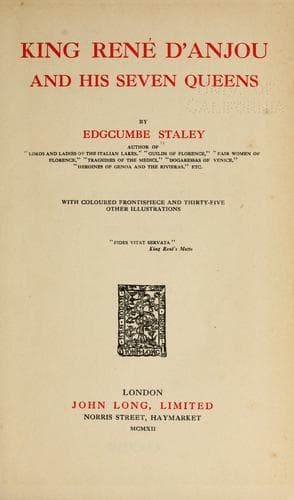
King René d'Anjou and His Seven QueensStaley, Edgcumbe
History
King René d'Anjou and His Seven Queens
Staley, Edgcumbe
France -- Court and courtiers; René I, King of Naples and Jerusalem, 1409-1480
The year that Louis XI., by his greed and treachery, drove his
noble uncle, “_le Bon Roy René_,” out of Anjou was one of trial and
embarrassment for the King of Sicily. At first his feelings, outraged
by the infamous behaviour of the son of his best-loved sister, Queen
Marie, got the better of his equanimity, and he gave way to indignant
protests; but when a man is in his sixties he learns to put up with
base affronts. René learned by sad experience to measure hypocrites
by their professions, but to leave their castigation to posterity. He
accepted philosophically, adverse circumstances as they arose and not
only checked the expression of his own sentiments, but discouraged
reprisals on the part of his impatient and indignant subjects. With
this same restraint the poet-King put forth a sententious drama, which
he entitled “_L’Abuzé en Court_”; we may translate it, perhaps, “The
Victim of Circumstances.” Its theme may be gauged as follows: Within
the shady portal of an ancient church,--the pavement strewn with the
persons of the blind and crippled seeking alms,--a pious wayfarer
beheld an oldish man whose silken though shabby attire spoke of better
days. His doublet was torn and his long poniard broken, his light brown
hair streaked with silver strands, and his pouch poorly furnished. The
wayfarer speaks kindly to the victim of Providence:
“Mon gentil homme, Dieu vous garde,
Et vous doint ce que déseriez.
Pardonnez moi, je vous en prie,
Et me dictez par courtousie
De vostre vie le renom
Que vous estez et vostre nom.”
“My good fellow, God protect you,
And grant you all that now you desire.
Forgive me fully, now I pray you,
And tell me something of your despair.
By your courtesy I would your name,
And your life’s story and deeds of fame.”
_L’Abuzé_ politely replies:
“Sire! pourquoi le demandez
C’est raison que je vous le dye.
J’ay nom sans que riens en mesdye
Le pouvre homme abuzé en court.”
Then he goes on to tell his story--the story of his life’s adversity,
a biograph of René’s. In happy days, now past, he had his amours and
his ambitions, his military exploits and his acts of peace. Much
of his time he had spent unselfishly caring for others, whose weal
depleted his purse and embarrassed his affairs until he was forced to
settle with his creditors. The narrative is worked out in dialogue
by the concourse of many speakers--among them a great lady, “_La
Court_”--Providence, and two _demoiselles_ of pity--“_Abuz_”--Wantoncy,
and “_Folcuideo_”--Mockery.
The _mise en scène_ varies as the tension, and the vicissitudes of
human life are presented under every aspect. The poem is a “morality,”
as that term was erstwhile understood.
The end of the whole matter is summed up characteristically as follows:
Public-domain text, read in full here on John Shaqi.
Reviews
Reviews
No reviews yet
Be the first to share your thoughts on this work.
Elsewhere in the archive
Join the Discussion
Join the discussion
Sign in to leave a comment or review.
Sign InorCreate an account