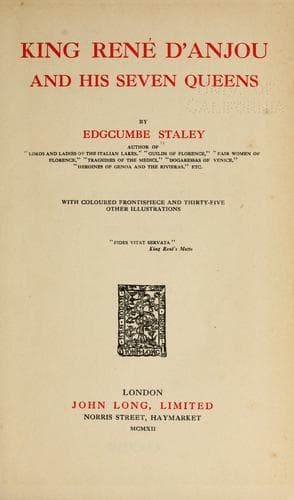
King René d'Anjou and His Seven QueensStaley, Edgcumbe
History
King René d'Anjou and His Seven Queens
Staley, Edgcumbe
France -- Court and courtiers; René I, King of Naples and Jerusalem, 1409-1480
“J’ay pascience!
Et pour vostre paine et salaire
Y-a-t-il aulcun que y pense?
Pour à voz loyers satisfaire
Que avez vous?
J’ay pascience!”
“Patience is mine!
For your ailing and for your health,
Is there anything for which you pine
Openly to gain, or by your stealth,
What would you?
Patience is mine!”
René and Jehanne went to Provence in 1473 in the guise of fugitives.
The Angevines deplored excessively this exile; they loved both King and
Queen, and Louis and all his works they hated cordially. René saw no
other course to follow. He was heavily cast down by family afflictions.
Jean, his noble eldest son, was dead; dead, too, were Charles d’Anjou,
his brother, and Nicholas, his dear grandson, and Ferri de Vaudémont.
He sought peace and consolation, and Provence and the Provençaux
offered both most loyally.
The story of Louis’s perfidy may be shortly told. In 1474 René
proclaimed Charles de Maine, his nephew, his heir to Anjou-Provence,
regardless of the French King’s presumptions. Louis summoned his uncle
to Paris to answer before the Parliament. Something of a compromise
was come to, for Louis said he should be content for Charles to be
proclaimed Duke and Count, but after him he or his heirs would annex
both duchy and county to France.
It had always been the policy of Sovereigns to encourage
knight-errantry and tournaments, for the competitors who assembled
became lieges of the lord. The names and performances of candidates
were inscribed on parchment rolls with gold and enamels; these were
read out aloud by tabarded heralds. The champions were escorted
in pageants to be decorated by the Queen or Lady President of the
“Lists”--a graduation, so to speak, in a world-wide University of
chivalry. In 1453 Duke Philippe of Burgundy instituted a very singular
festival, “The Pageant of the Pheasant,” in which knights were made
to swear for Church and fame. The oath ran as follows: “I _N._ swear
before God, my Creator, in the first place; the ever-glorious Mary,
His mother; and, lastly, before these ladies of the tournament and the
Pheasant, to be a true and Christian knight.” The Pheasant was the
emblem of fecundity, the mascot of would-be brides and mothers!
Public-domain text, read in full here on John Shaqi.
Reviews
Reviews
No reviews yet
Be the first to share your thoughts on this work.
Elsewhere in the archive
Join the Discussion
Join the discussion
Sign in to leave a comment or review.
Sign InorCreate an account