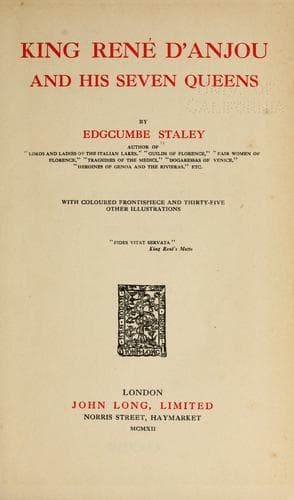
King René d'Anjou and His Seven QueensStaley, Edgcumbe
History
King René d'Anjou and His Seven Queens
Staley, Edgcumbe
France -- Court and courtiers; René I, King of Naples and Jerusalem, 1409-1480
King Juan threw himself unreservedly into the arms of his merry
Minerva-Venus Queen: no doubt she “plucked” him thoroughly! A “Court of
Love” was established at Zaragoza. All day long they danced, and all
night through they sang, and at all times played their floral games,
whilst dour señors scowled and proud dueñas grimaced. The revels of the
“_Gaya Ciencia_” shocked their susceptibilities, until a crisis was
reached in 1340, when the King sent embassies to all the French Courts
to enlist the services of their best troubadours. A solemn session
of the Cortes, wherein resided the actual power of the State,--the
King was King only by their pleasure,--was called, “_Podemos mas
que vos_”--“We are quite as good as you, or even better”--that was
the moving spirit of Aragon. A resolution was passed demanding the
suppression of “the feast of folly,” as the gay doings at Court were
called, and the immediate expulsion of the foreign minstrels and their
hilarious company.
Here was a fix for the easy-going King,--dubbed by many
“_l’Indolente_,” the Indolent,--between the devil and the deep sea.
The Queen point-blank refused to say good-bye to her _devotés_, and
her wiles prevailed to retain many a merry lover at her Court, for the
stoutest will of man yields to the witchery of beauty in every rank of
life!
If Queen Yolanda was a “gay woman,” as historians have called
her,--and no class of men are anything like so mendacious,--she was not
the “fast” woman some of them have maliciously styled her. No, she was
a loving spouse and a devoted mother. Perhaps, could she have chosen,
she would have brought forth a boy; but, still, every mother loves her
child regardless of sex or other considerations. She addressed herself
zealously to the rearing of the little princess. No sour-visaged
_hidalgo_ and no censorious citizen was allowed the entrée to the
nursery. Minstrels rejoiced at the nativity, and minstrels shared
the rocking of the cradle. She was baptized at the old mosque-like
cathedral of Sa Zeo, or San Salvador,--where the Kings her forbears
were all anointed and crowned,--with the courtly ceremonial of Holy
Church, whilst outside the people sang their well-loved ditties. Quite
the favourite was “_Nocte Buena_”--
“La Vergin se fui’ in lavar
Sui manos blancas al rio;
El Sol sequedó parado,
La Mar perdio su ruido,” etc.
“To the rivulet the Virgin sped,
Her fair white hands to wash;
The wandering Sun stood still o’erhead,
The Sea cast up no splash,” etc.
and many, many other verses. Zaragoza was famous for the splendour
of her mystery plays, as many quaint entries in the archives of the
archdiocese prove: “Seven _sueldos_ for making up the heads of the ass
and the ox for the stable at Bethlehem; six _sueldos_ for wigs for the
prophets; ten _sueldos_ for gloves for the angels.”
Public-domain text, read in full here on John Shaqi.
Reviews
Reviews
No reviews yet
Be the first to share your thoughts on this work.
Join the Discussion
Join the discussion
Sign in to leave a comment or review.
Sign InorCreate an account