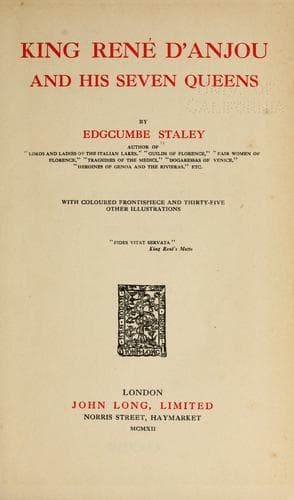
King René d'Anjou and His Seven QueensStaley, Edgcumbe
History
King René d'Anjou and His Seven Queens
Staley, Edgcumbe
France -- Court and courtiers; René I, King of Naples and Jerusalem, 1409-1480
Troubadours and “Courts of Love” were complements of warlike deeds on
stricken field or in tilting-joust. The Provençal seigneurs and their
ladies lived in lonely castles, with nothing on earth to do. Provence
was the cradle of the troubadours. Every troubadour had to choose the
lady of his passion; she might return it or not, as she chose. It was
Guillaume de Poitou, a very famous troubadour, who gave the maxim: “If
you propose a game of love, I am not too foolish to refuse, but I shall
choose the side that is the best.” All this appealed to King René, and
his bent fell in distinctly with that of the famous troubadours of the
past. His poetic and sentimental nature found reflective expression in
the old “_Magali_,” of the popular melodies of Provence:
“O Magali ma tant amado,
Mete la tête au fenestroun,
Esecuto un pan aguesto subado
De Tambourine, de Viouloun
Esplein estello paramount,
L’Auro os tournado
Mailes estello paliran
Quand te verraut.”
This was the spirit of the life to which King René introduced his young
and beauteous consort--a romantic existence which appealed forcibly
to the sweet instincts of the royal bride. Her response was the joy
of René’s heart; if denied the fruit of sexual love, he and she were
productive of the issue of kindred souls. They lived for one another in
an elysium of bliss, chaste and unalloyed, with no qualms of conscience
and no aftermath of reproach.
René’s love of Jehanne became a passion; her freshness and animation
and the evenness of her disposition were to him like so many springs of
invigorating water, whence, quaffing, he ever rose to new activities.
She became the inspirer of his poetry, the spur in his official duties,
and the pivot of his benevolence. He was never tired of extolling her
virtues in prose and verse, nor of painting her in miniature and in
large. It was said that he always carried about with him wherever he
went her portrait, which he himself painted upon a small oval piece
of walnut wood let into a locket frame of chiselled gold and enamel.
More than this, his most treasured trophy of the “Lists”--the lance
with which he unseated Charles VII. at the nuptial tournament for Queen
Marguerite d’Anjou--contained an orifice wherein he inserted another
likeness of “_la bonne Jehanne_.” In the inventory of his garderobe
at Angers Castle we read: “_Item, Ung bois de lance creux, ou il y a
dedans un rollet de parchemin, auquel c’est dedans la portraicture de
la Royne de Sicile._”[A]
[A] “Item, A hollow lance pole wherein there is a roll of
parchment upon which is a portrait of the Queen of Sicily.”
Public-domain text, read in full here on John Shaqi.
Reviews
Reviews
No reviews yet
Be the first to share your thoughts on this work.
Elsewhere in the archive
Join the Discussion
Join the discussion
Sign in to leave a comment or review.
Sign InorCreate an account