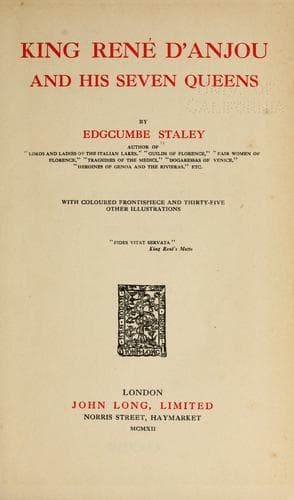
King René d'Anjou and His Seven QueensStaley, Edgcumbe
History
King René d'Anjou and His Seven Queens
Staley, Edgcumbe
France -- Court and courtiers; René I, King of Naples and Jerusalem, 1409-1480
René had been in early life remarkable for his simple tastes and
abstemiousness in food and drink, and Queen Isabelle was equally
careful in personal matters. Their lives were passed in strenuous times
when self-denial required great sacrifices of individual indulgences.
Isabelle was a soldier’s wife, Jehanne the consort of a statesman when
life’s battle had given way to the ease of peace. Both were attractive
women, few their superiors, but Isabelle’s hand was upon the hilt of
the sword and the snaffle of the charger. Jehanne’s held the mirror of
fashion and the goblet of pleasure. After René and Jehanne had arranged
their domestic settlement in Provence, at once their Court became noted
for its magnificent hospitality. René employed the first master-cook of
the day, Maestro Guillaume Real, as his Master of the Household. People
nicknamed him “_Courçon_,” as marshal of the courses of a banquet,
rather than “_Soupçon_,” the secret of each! The royal repasts were
arranged as spectacles; at the cross high table were placed the hosts
and guests of honour, and at tables down the hall other guests were
accommodated. The walls were hung with silver and crystal sconces full
of torches or tapers, and the trophies of war and the chase belonging
to the house were there displayed. The covers and the service were as
rich and costly as could be. Gold, enamels, crystals, rare faience, and
other art treasures, were used with lavish taste.
Each course was proclaimed heraldically by blasts of horns and
_motets_ from the music gallery. The high table was served by knights
and men of rank, who bore the splendid bowls and dishes upon napery of
cloth of gold. The richer viands were enclosed in golden caskets, and
the keys offered to the guests, who in turn unlocked them and took or
refused their contents. Some of the confections have not their parallel
to-day. One table, for example, was made to represent a stag-hunt,
another a village revel, one a castle with a moat of rare vintage,
another an abbey church with bells pealing and hidden children singing.
Small animals and birds, and actually growing trees and flowers, were
used. The roast and the dessert were the _pièces de résistance_; each
was carried up the hall in gay procession with much ceremonious bowing,
and guarded by archers of the guard in gorgeous liveries. At the sight
of any very splendid and appealing course the whole lordly company were
wont to burst out into song--a well-known and lengthy _chanson_; it was
called “_Le Sauve-garde de ma Vie_.”
Public-domain text, read in full here on John Shaqi.
Reviews
Reviews
No reviews yet
Be the first to share your thoughts on this work.
Elsewhere in the archive
Join the Discussion
Join the discussion
Sign in to leave a comment or review.
Sign InorCreate an account